1. Introduction
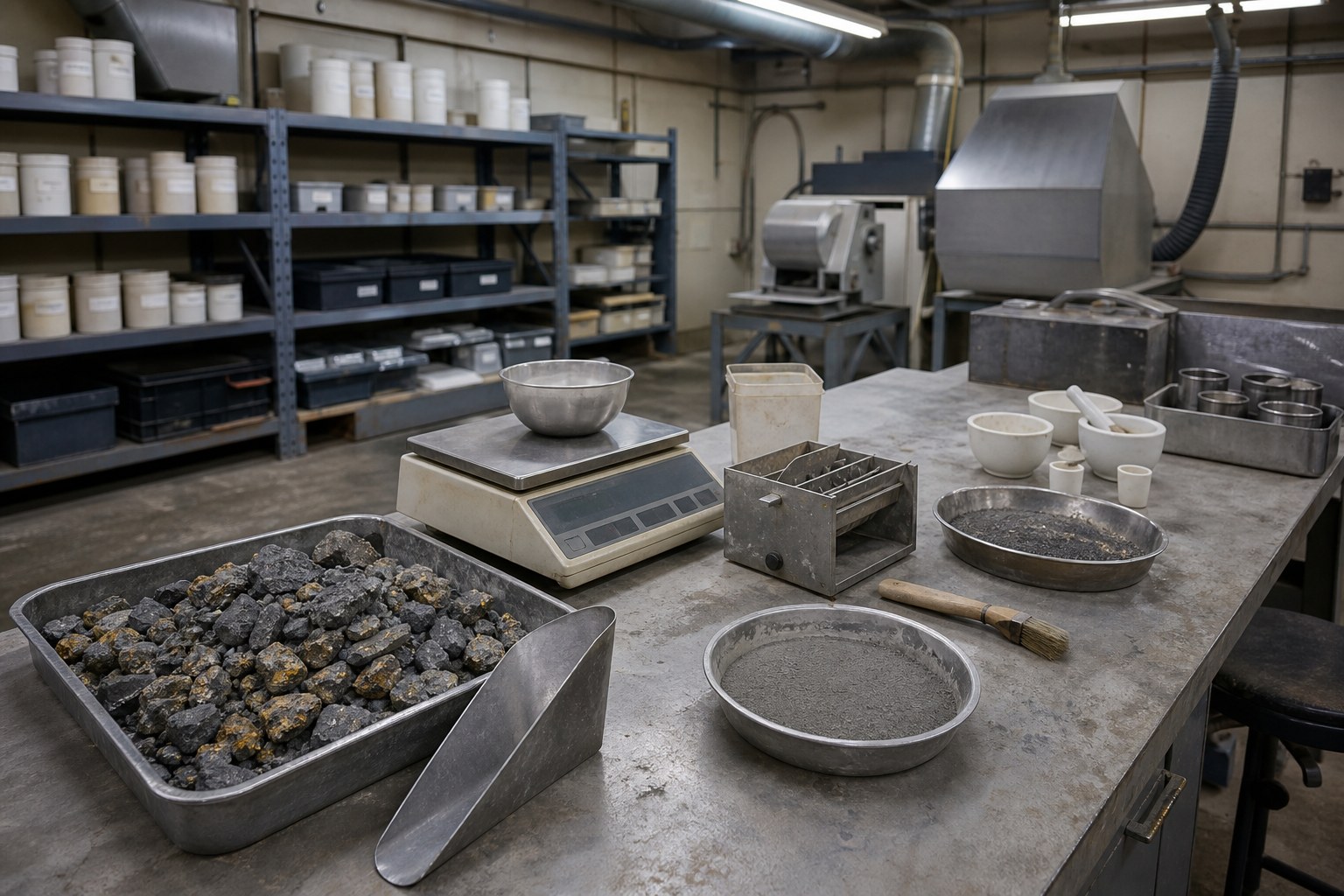
In a mining laboratory, the assay result does not begin at the instrument. It begins when the sample is received, identified, dried, crushed, split, pulverized, weighed, corrected, checked and finally released into an analytical workflow. By the time a value reaches ICP, AAS, XRF or fire assay reporting, much of its reliability has already been determined by sample preparation.
That is why sample preparation should not be treated as a manual side process outside the LIMS. In high-throughput assay environments, preparation is a controlled pre-analytical layer: it defines sample identity, representativeness, moisture basis, contamination risk, duplicate precision, CRM recovery, operator accountability and the technical record required for ISO/IEC 17025 audits.
A Mining Laboratory LIMS must therefore do more than store final results. It must connect the physical preparation workflow to the digital evidence chain — from reception and barcode tracking to electronic worksheets, balance capture, QA/QC validation, audit trails, approval and certificate release.
2. The result is only as defensible as the prepared sample
Mining samples are not homogeneous laboratory specimens. Ore, concentrate, core, pulp, solution and process samples often carry natural variability before they ever enter the laboratory. Size distribution, moisture, segregation, contamination and sub-sampling all influence whether the final aliquot is representative of the material that was originally received.
This makes sample preparation one of the highest-risk stages in the laboratory workflow. A perfectly calibrated instrument can still produce a misleading result if the wrong sample was prepared, if a split was not representative, if moisture correction was handled inconsistently, if a duplicate was misplaced, or if preparation records cannot be reconstructed during an audit.
The operational risk is also practical. Mining laboratories work under pressure: production decisions, shipment timing, plant control, metallurgical accounting and environmental reporting often depend on fast turnaround time. When preparation steps are tracked on paper, spreadsheets or informal bench notes, laboratories may keep moving — but the evidence chain becomes fragmented.
A specialized LIMS changes the question from “where is the final result?” to “can we defend every controlled step that produced that result?”
3. From physical workflow to digital evidence
A typical mining sample may pass through reception, drying, crushing, splitting, pulverizing and weighing before analytical determination. Each of those stages should leave a controlled digital trace.
At reception, the laboratory needs to confirm sample identity, condition, source, batch, priority and requested methods. Barcode and label workflows reduce the risk of manual identification errors and give the laboratory a consistent way to move samples between areas. Status tracking helps supervisors understand whether a sample is received, in preparation, ready for analysis, under review, blocked, approved or reported.
During drying and moisture-related work, the laboratory may need to control method, timing, temperature, weight basis and calculation logic. Wet-basis and dry-basis values are not interchangeable. If moisture correction is part of the analytical chain, the LIMS must preserve the measurement, the calculation and the user action that produced the adjusted result.
Crushing, splitting and pulverizing introduce a different class of risk. The issue is not only whether the step was done, but whether it was done under the correct method, equipment, sequence and batch context. Cross-contamination, carryover, poor cleaning, segregation and incorrect splits can all affect the final analytical value.
Weighing is another critical control point. Manual transcription of weights is one of the simplest ways to introduce silent error into a laboratory process. Where balances or preparation equipment can export values through serial, network or file-based interfaces, the LIMS should capture those values directly or through controlled import routines.
4. Why spreadsheets are not enough for preparation control
Spreadsheets can be useful calculation tools, but they are weak evidence systems when used as the main control layer for a mining laboratory. Formula changes may not be versioned. Weight entries may be typed by hand. Copies of files may circulate outside the approved workflow. A corrected value may overwrite the original value without a clear record of who changed it and why.
In sample preparation, this weakness is amplified because the work is physical. The laboratory is not only managing numbers; it is managing material. A spreadsheet may calculate a dilution factor or moisture correction, but it does not necessarily know the sample status, the batch context, the preparation sequence, the QC position, the instrument handoff, the approval state or the audit requirement behind that number.
This is where OnLIMS is positioned differently from a generic data repository. OnLIMS is designed for mining and industrial assay laboratories where sample lifecycle, QA/QC, worksheets, instrument integration and reporting are part of one operational system.
5. QA/QC begins before publication, not after failure
Quality control cannot be treated as a final review step disconnected from preparation. In mining laboratories, blanks, duplicates, certified reference materials, check standards and other controls must be inserted, tracked and evaluated in relation to the batch and method.
Preparation-stage QA/QC helps identify contamination, precision issues, representativeness problems and method instability before the laboratory publishes results. Duplicate precision may reveal preparation or sub-sampling variability. Blanks may reveal contamination or carryover. CRMs and control samples help confirm that the analytical path remains within acceptable performance.
The value of QA/QC increases when it is integrated into the LIMS rather than reviewed manually after the fact. Control charts, LCL/UCL enforcement, duplicate analysis and non-conformance handling allow the laboratory to hold, investigate and release batches under a controlled process.
6. Instrument handoff starts in preparation
The boundary between preparation and instrumentation is often more connected than it appears. A prepared sample may determine dilution, solids handling, calibration range, method selection or whether additional checks are needed before analysis.
Instrument software and preparation equipment often provide structured data that can be captured by a LIMS: weight values, result files, calibration logs, CSV exports, ASCII formats, serial outputs, XML blocks or raw data records. In a controlled environment, those outputs should not remain isolated inside instrument software or local folders.
OnLIMS supports mining laboratory integration through parser-based and file-based import patterns, direct communication approaches and controlled result capture workflows. This reduces manual transcription and helps preserve the evidence chain between preparation, analysis, QA/QC and reporting.
7. Audit trails protect the laboratory record
In high-volume laboratories, corrections happen. Values may be reviewed, recalculated, re-entered, re-imported or blocked. The issue is not whether changes occur; the issue is whether they are controlled.
A defensible laboratory system must preserve original values, modified values, timestamps, users and reasons where applicable. It must also prevent uncontrolled edits after approval and support electronic locks or status controls that protect published results.
By connecting preparation records, worksheets, QA/QC evaluation and approval workflows, a Mining Laboratory LIMS helps the laboratory maintain a complete technical record rather than a loose collection of files.
8. Sample preparation as a management layer
For laboratory managers, sample preparation is not just a bench workflow. It is a management layer that affects turnaround time, resource planning, rework, quality risk and customer confidence.
A LIMS-controlled preparation workflow allows supervisors to see bottlenecks, identify blocked batches, monitor pending work, review QC status and understand whether samples are ready for analysis or still waiting for preparation completion. This helps the laboratory move from reactive follow-up to operational control.
9. Conclusion: before the assay, control the evidence
Mining laboratories often focus technology discussions on instruments, analytical methods and final results. Those areas matter, but they are not enough. The reliability of a result is shaped earlier, in the pre-analytical preparation workflow where physical samples become controlled laboratory data.
Drying, crushing, splitting, pulverizing, weighing, moisture correction, QC insertion and batch release are not peripheral tasks. They are the first control points of mining laboratory data integrity.
When OnLIMS connects sample lifecycle management, electronic worksheets, QA/QC validation, instrument integration, audit trails and reporting, it helps laboratories defend not only the final number — but the complete process that produced it. In mining, the assay result begins before the assay. The laboratory system should reflect that reality.