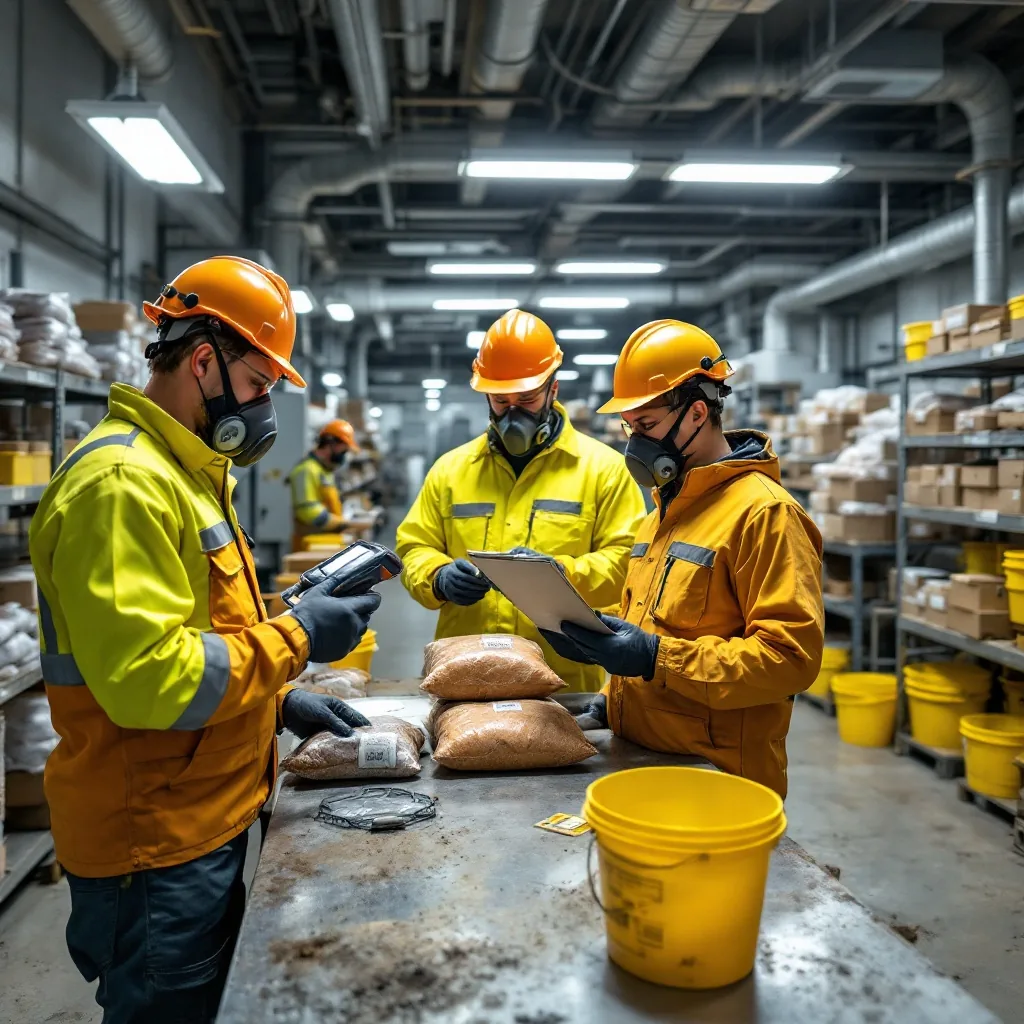
Why a Defensible Result Depends on the Path Before It
In a mining laboratory, the analytical result is only as defensible as the path the sample followed before that result was produced. A gold assay, an ICP-OES multi-element result, an XRF confirmation, or a gravimetric finish may look precise at the reporting stage, but that precision loses operational value if the laboratory cannot prove which sample was received, how it was registered, who handled it, where it was processed, which batch it entered, which controls were inserted, which instrument generated the data, and under what conditions the certificate was released.
That is why chain of custody should not be treated as a document attached to the end of the laboratory process. In a modern mining operation, chain of custody is the control layer that connects the entire sample lifecycle. It begins at reception, continues through dispatch, preparation, aliquoting, digestion, fire assay, ICP, XRF, balance integration, QA/QC validation, result approval, and final certificate generation. When that chain is fragmented across notebooks, spreadsheets, shared folders, and disconnected instrument exports, the laboratory may still produce numbers, but it cannot reliably defend the path behind those numbers.
For mine-site laboratories, this is not a theoretical risk. High sample volumes, multiple preparation lines, urgent production decisions, repeated re-assays, split samples, check assays, CRMs, blanks, duplicates, and instrument-specific workflows create a dense operational environment where small identity errors become expensive very quickly. A mislabeled pulp, an undocumented batch transfer, a manual transcription mistake, or an unresolved custody gap can delay reporting, trigger unnecessary rework, weaken ISO 17025 audit readiness, or reduce confidence in production and metallurgical decisions.
From Barcode Reception to Controlled Sample States
OnLIMS approaches this problem from the perspective of a mining laboratory, not a generic laboratory template. The system is designed to manage the sample lifecycle as a sequence of controlled operational states: reception, login, labeling, dispatch, preparation, analytical processing, QA/QC validation, review, reporting, and certification. Each state must preserve sample identity and make the next operation traceable.
At the reception stage, the first priority is to establish a reliable digital identity. Samples arriving from exploration, production, metallurgical campaigns, environmental monitoring, or third-party dispatches need to be registered in a way that reflects the actual structure of the mining operation. Barcode and label printing are not cosmetic features in this context. They are the foundation for eliminating ambiguity between physical sample containers, laboratory work orders, preparation batches, analytical methods, and final reporting structures.
Once the sample is inside the laboratory, custody becomes a question of controlled movement. A mining laboratory LIMS must know whether a sample is waiting for preparation, dispatched to crushing, queued for splitting, pulverized, assigned to fire assay, prepared for digestion, loaded for ICP-OES or ICP-MS, measured by XRF, or pending QA/QC release. Without this state model, supervisors are forced to manage the laboratory through manual follow-up and informal knowledge. That creates hidden turnaround time, especially when hundreds or thousands of samples are moving across benches, racks, balances, furnaces, digestion areas, and instruments.
OnLIMS reduces that ambiguity by linking sample status tracking with batch management and laboratory workflow control. The point is not only to store a sample record. The point is to make the record operational. A supervisor should be able to identify where a sample is, what processing state it belongs to, whether the batch has passed internal controls, whether a result has been captured, and whether any condition is blocking release. This is where chain of custody becomes part of throughput management, not only compliance documentation.
When CRMs, Duplicates and Instrument Feeds Become Custody Evidence
The custody model also needs to extend into QA/QC. In mining laboratories, quality control is not separate from sample identity. Certified Reference Materials, blanks, duplicates, check standards, and control limits must be inserted, tracked, and interpreted in relation to the batches and methods they are intended to validate. If a CRM fails, if a duplicate exceeds acceptable precision limits, or if a blank indicates possible contamination, the laboratory must understand exactly which samples are affected and what release decisions need to be blocked.
This is where a specialized mining LIMS becomes materially different from a spreadsheet-driven workflow. OnLIMS supports automated QA/QC structures such as CRM, blank, and duplicate insertion, Shewhart control charts with LCL/UCL enforcement, Thompson-Howarth duplicate precision analysis, non-conformance flagging, and status blocks for non-conforming results. These controls are only valuable when they are connected to custody and batch context. A failed control is not just a data point; it is an operational event that must protect the integrity of the certificate.
Instrument integration is another critical part of the custody chain. Manual result entry creates a weak link between the physical sample and the reported value. Even when analysts are careful, high-volume laboratories face structural risk when data must be copied from balances, ICP files, XRF systems, fire assay records, or other instrument outputs into separate systems. OnLIMS addresses this through direct TCP/IP and RS232 parser connections, file-based import parsers, and automatic result import for instruments such as ICP-OES, ICP-MS, AAS, XRF, analytical balances, fire assay balances, and PGNAA conveyor analyzers.
The Certificate as a Decision Artifact: Audit Readiness and 24/7 Continuity
The operational impact is direct: fewer transcription errors, stronger traceability, faster review, and a cleaner audit trail between instrument output and final certificate. For mining laboratories that already operate under production pressure, this matters because the certificate is not merely a report. It is a decision artifact used by geology, metallurgy, plant operations, commercial teams, and quality managers. If the custody trail behind the certificate is weak, the organization carries hidden risk even when the analytical number appears complete.
A strong chain-of-custody system also protects production continuity. Laboratories are often expected to operate 24/7 while supporting mine planning, mill feed decisions, shipment controls, environmental monitoring, and metallurgical reconciliation. In that environment, delays are not only laboratory delays; they become operational delays. A sample waiting for review, a batch held without visibility, or a certificate blocked by unresolved QA/QC can affect downstream decision-making. OnLIMS provides the digital structure needed to identify those blocks before they become systemic bottlenecks.
The compliance dimension is equally important. ISO 17025 readiness requires more than evidence that a test was performed. It requires confidence in the process that produced the result: sample identification, method control, personnel actions, equipment data, validation logic, result review, non-conformance management, and record retention. OnLIMS supports this through audit trails, status controls, historical QC record retention, electronic sample locks, and structured laboratory workflows designed for mining environments.
Electronic locks and status controls are especially relevant in multi-user laboratories. When several technicians, supervisors, QA/QC managers, and administrators interact with the same operational data, concurrency problems can become a source of silent data corruption. OnLIMS uses electronic sample locks and controlled status transitions to prevent conflicting edits and preserve process integrity. This is a practical requirement in real laboratories where work is distributed across shifts, benches, instruments, and departments.
For executives, the strategic lesson is clear: chain of custody is not an administrative detail. It is an operating model. A laboratory that can prove custody, enforce QA/QC, automate instrument data capture, preserve audit trails, and release certificates with confidence is not only better evidenced. It is more predictable, more defensible, and better connected to the production realities of mining.
OnLIMS was built around that operating reality. With more than two decades of production history in mining and industrial assay laboratories, a C#/.NET and SQL Server architecture, on-premise deployment, and 24/7 mine-site orientation, the platform is designed for environments where laboratory data must remain controlled, available, and defensible without cloud dependency or third-party exposure.
The future of mining laboratory automation will not be defined only by faster instruments or better dashboards. It will be defined by the strength of the digital chain that connects every sample movement, every preparation step, every QA/QC decision, every instrument result, and every certificate released to the business. For laboratories that support high-value mining decisions, that chain is the foundation of trust.