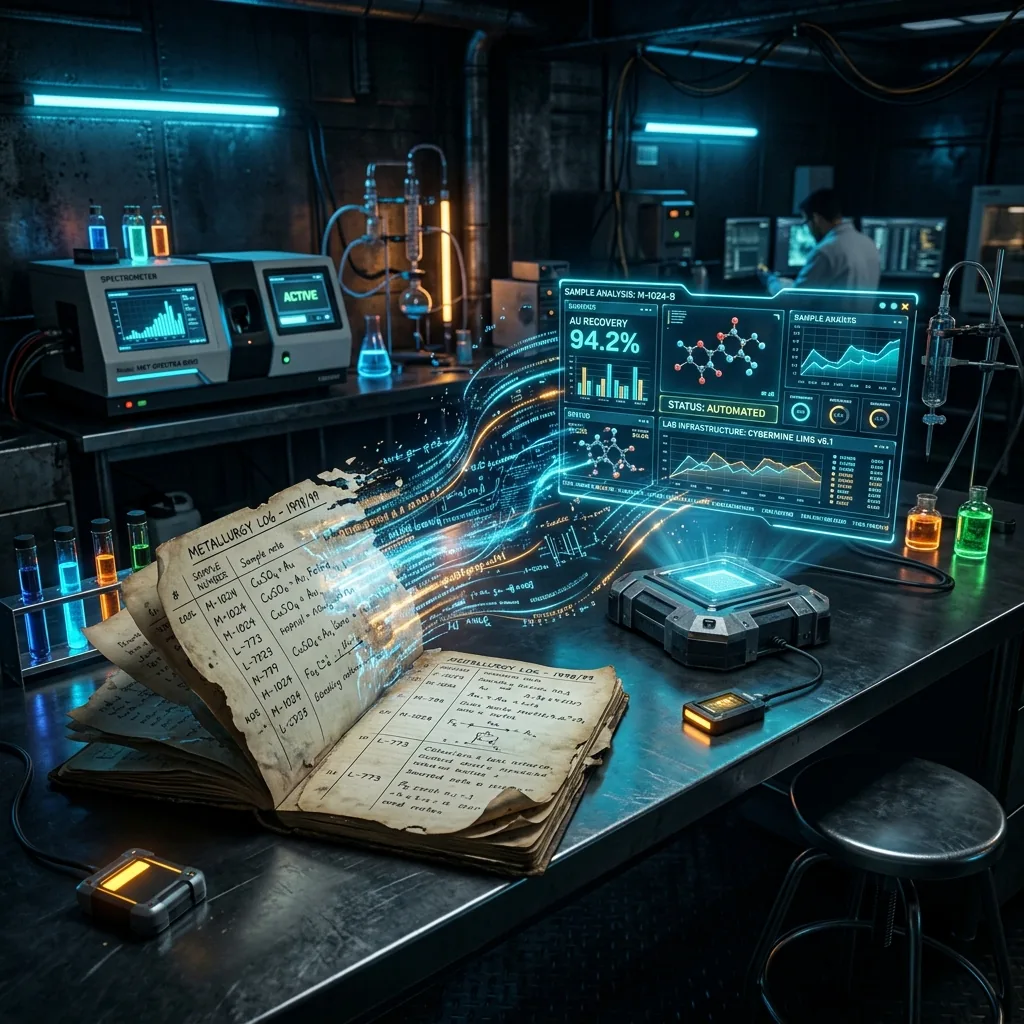
The Hidden Cost of Chain of Custody in High-Throughput Assay Labs
In high-throughput mining operations, the laboratory serves as the critical decision-making hub for ore grade control, metallurgical recovery, and environmental compliance. However, the sheer volume of samples processed daily often creates a massive administrative burden—a "headache" that extends far beyond the technical act of chemical analysis. The complexity arises from the need to maintain a rigorous chain of custody and ensure that every single sample is tracked from the moment it arrives at the reception desk until the final report is issued. When laboratories rely on fragmented systems, the administrative overhead required to maintain traceability often consumes a disproportionate amount of technical personnel's time.
The technical challenge is centered on the synchronization of raw data with reporting outputs. In many assay laboratories, the transition from the bench worker's recording process to the final certificate is a manual, multi-step journey. This process involves the movement of data across worksheets, notebooks, and spreadsheets, creating multiple points of potential failure. For a mining laboratory to remain viable and audit-ready, it must move away from these manual synchronization efforts and toward a centralized system that manages the sample lifecycle as a single, continuous digital thread, thereby reducing the cognitive load on laboratory staff and minimizing the risk of transcription errors.
Why the Notebook-and-Worksheet Paradigm Still Drains Lab Productivity
The most significant operational burden in mining laboratories is the management of raw data and the administration of work. According to industry standards for laboratory competence, such as ISO 17025, the recording of results must be systematic and controllable. However, in practice, many labs still struggle with the "notebook and worksheet" paradigm. When results are handwritten in notebooks or logged in isolated spreadsheets, the laboratory manager must implement exhaustive manual checks to ensure that calculations are correct and that data transfers are accurate. This creates a bottleneck where senior chemists spend more time auditing paper trails than optimizing assay methods.
- Data Transcription Fatigue: The manual transfer of assay results from instrument readouts or notebooks into a final report is the primary source of clerical errors. This repetition not only slows down the reporting cycle but increases the probability of "fatigue-induced" errors, where a single digit is misplaced, potentially leading to incorrect ore grade interpretations.
- Chain of Custody Fragmentation: Managing sample numbering and labelling manually often leads to discrepancies between the physical sample and its digital record. When the allocation of work is handled via paper lists, tracking the current location of a sample batch across preparation, digestion, and analysis stages becomes a logistical nightmare.
- Compliance Documentation Overhead: Meeting ISO 17025 requirements for data control and information management requires rigorous documentation. The effort spent maintaining numbered notebooks, ensuring pages aren't torn out, and cross-referencing worksheets to notebook pages creates a significant administrative drain on laboratory personnel.
Digitizing the Work Administration: From Bench Entry to a Single Digital Thread
OnLIMS addresses these burdens by replacing fragmented manual processes with a specialized Mining Laboratory LIMS. Instead of relying on the precarious link between notebooks and spreadsheets, OnLIMS digitizes the entire administration of work. By implementing a centralized system, the laboratory ensures that the communication of client requirements to bench workers is instantaneous and unambiguous. The system eliminates the need for manual worksheets by providing digital interfaces where results are recorded directly, ensuring that the data is captured at the source and is immediately available for quality checking.
Furthermore, the software supports workflow automation by integrating sample numbering and labelling into a digital chain of custody. This means that the "headache" of tracking batches is solved through real-time visibility; managers can see exactly which stage of the assay process a sample is in without having to physically search the lab or check a paper log. By automating the data transfer process, OnLIMS removes the need for manual transcription, which directly addresses the most significant source of error in the lab. The system ensures that calculations are performed systematically and that any amendments to reports are tracked through a transparent audit trail, aligning perfectly with the strict data control requirements of high-value mining operations.
Higher Throughput, Fewer Transcription Errors: Turning Compliance Into a Byproduct
The transition from a manual or mixed system to a specialized Mining Laboratory LIMS yields immediate, measurable improvements in laboratory efficiency. By reducing the time spent on administrative data entry and manual auditing, laboratories can significantly increase their sample throughput without increasing headcount. The reduction in transcription errors leads to higher data integrity, which is critical for QA/QC Mining Labs where a minor error in a CRM or duplicate result can trigger a costly and unnecessary investigation.
In conclusion, the administrative burden in mining laboratories is not an inevitable part of the process, but a symptom of legacy workflows. By implementing a solution focused on Assay Laboratory Management and Laboratory Automation Mining, laboratories can shift their focus from "managing paper" to "managing chemistry." The result is a streamlined operation where ISO 17025 compliance is a natural byproduct of the workflow rather than a stressful manual exercise. OnLIMS provides the technical framework necessary to eliminate the operational bottlenecks that plague laboratory personnel, ensuring that the path from sample reception to final report is fast, accurate, and fully traceable.