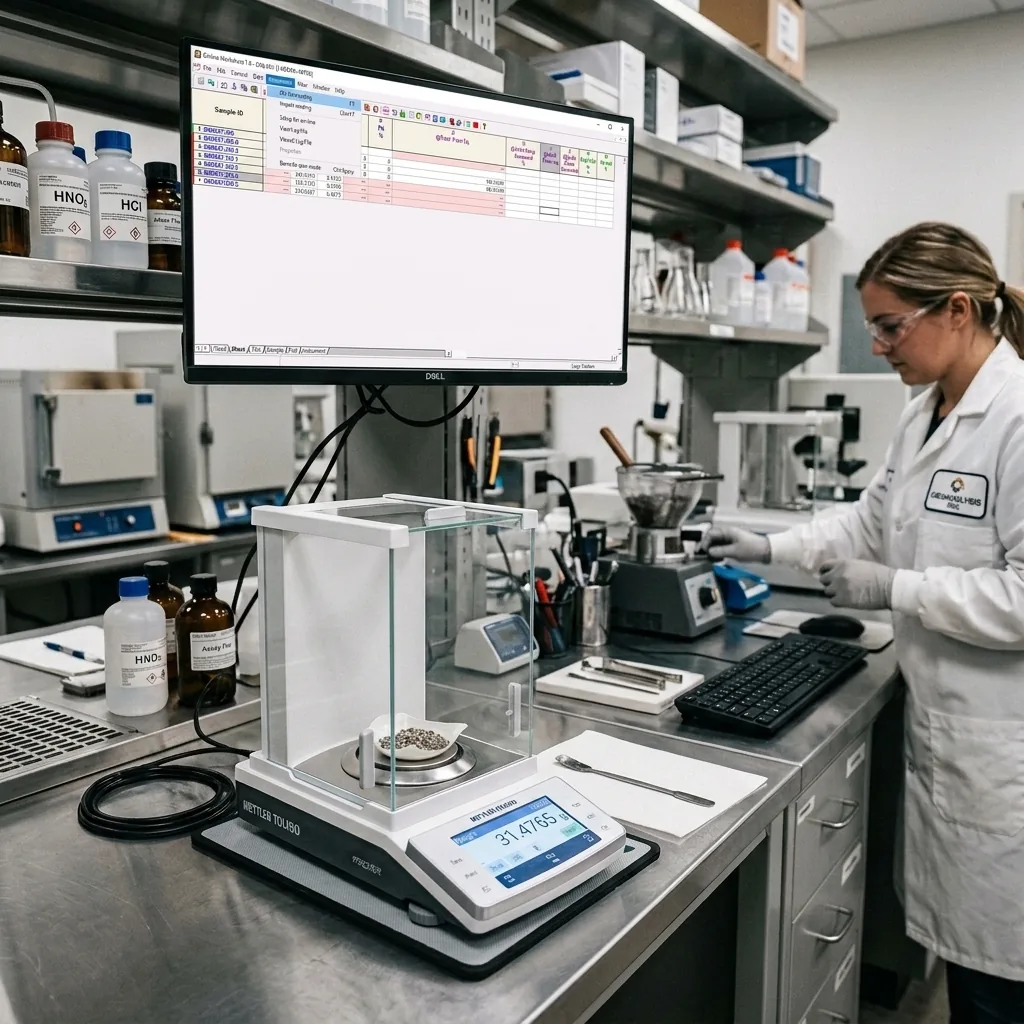
Why the Weighing Station Is the Weakest Link in Assay Data
In the rigorous environment of a mining assay laboratory, the precision of gravimetric measurements is the foundation of all subsequent analytical results. Whether measuring the mass of a pulp sample for digestion or weighing high-purity standards for calibration, the accuracy of the initial weight directly impacts the final grade calculation. In high-throughput operations, where thousands of samples are processed daily, the volume of data generated at the weighing station is immense. Traditionally, this data has been captured manually, creating a precarious reliance on the technician's ability to transcribe digits from a digital display to a logbook or spreadsheet without error.
A specialized Mining Laboratory LIMS addresses this vulnerability by transforming the balance from a standalone tool into an integrated data node. By establishing a direct communication link between the weighing instrument and the LIMS software, laboratories can implement a "zero-transcription" workflow. This technical alignment ensures that the exact value displayed on the balance is captured and stored in the database in real-time, eliminating the risk of human transposition errors and significantly reducing the time spent on manual data entry. For labs operating under strict QA/QCMining Labs protocols, this automation is not merely a convenience but a necessity for maintaining data integrity.
The Hidden Cost of Manual Weight Entry: Slipped Digits and False QC Failures
The reliance on manual data entry for weight measurements introduces several systemic risks that can compromise the validity of an entire assay batch. When a technician manually records weights, the probability of "transcription slip"—such as swapping two digits or misplacing a decimal point—increases proportionally with the volume of samples. In a mining context, a small error in the initial sample weight can lead to significant discrepancies in the calculated metal concentration, potentially resulting in incorrect ore grade estimations and costly operational decisions in the mine plan.
- Data Integrity Gaps: Manual logs often lack a verifiable audit trail. There is no technical way to prove that the number written in a notebook was the exact number displayed on the balance at that precise moment, which complicates ISO 17025 compliance audits.
- Workflow Bottlenecks: The process of weighing a sample, writing the value, and later typing it into a spreadsheet creates a significant time lag. This redundancy slows down the sample preparation phase and delays the movement of materials to the digestion or fusion stage.
- Increased QC Failure Rates: Transcription errors are often mistaken for analytical errors. When a CRM (Certified Reference Material) fails a QC check, supervisors may spend hours troubleshooting the ICP or AAS instrument, only to discover the error occurred during the initial weighing stage.
Direct Balance-to-LIMS Capture: Scan, Capture, Record
The implementation of a Mining Laboratory LIMS designed for instrument integration solves these challenges by utilizing standardized communication protocols (such as RS232, USB, or TCP/IP) to bridge the gap between the balance and the server. The workflow is redesigned so that the technician simply scans the sample barcode and triggers the "capture" command within the LIMS. The LIMS then reads the value delivered by the balance and automatically populates the corresponding field in the database. Weight stabilization is a balance setting: the balance is configured to deliver a value only once the reading is stable, and the LIMS captures that value as delivered.
Out-of-range checks are also balance settings: weighing limits and tolerances are configured on the balance itself, so the balance decides which readings it releases, and the LIMS records the value the balance delivers, linked to the sample barcode, with no retyping. Furthermore, this automation supports Laboratory Automation Mining goals by creating a digital chain of custody that begins the moment the sample is first weighed. By removing the human interface from the data transfer process, the laboratory ensures that the raw data is immutable and traceable, which is a core requirement for any modern geochemical or metallurgical facility.
Fewer Re-Assays, Faster Prep, and an Unbroken Chain of Custody
The transition from manual weighing to an integrated Mining Laboratory LIMS provides measurable improvements in both operational efficiency and data quality. Laboratories typically observe a drastic reduction in the "re-assay" rate caused by clerical errors, and the time required for the sample preparation phase is reduced as the need for double-entry is eliminated. More importantly, the ability to generate real-time reports on sample weights allows supervisors to monitor throughput and identify bottlenecks in the preparation area without having to manually review logs.
In conclusion, the integration of balances into a specialized Mining Laboratory LIMS is a critical step in the digitalization of the assay process. By replacing manual transcription with automated data capture, labs can achieve a level of precision and traceability that is impossible with spreadsheets or paper logs. This technical shift not only supports ISO 17025 compliance but also protects the laboratory from the financial and operational risks associated with inaccurate assay data. For mining operations where precision is the primary KPI, automating the connection between the balance and the LIMS is the only way to ensure that the analytical chain remains unbroken and credible.