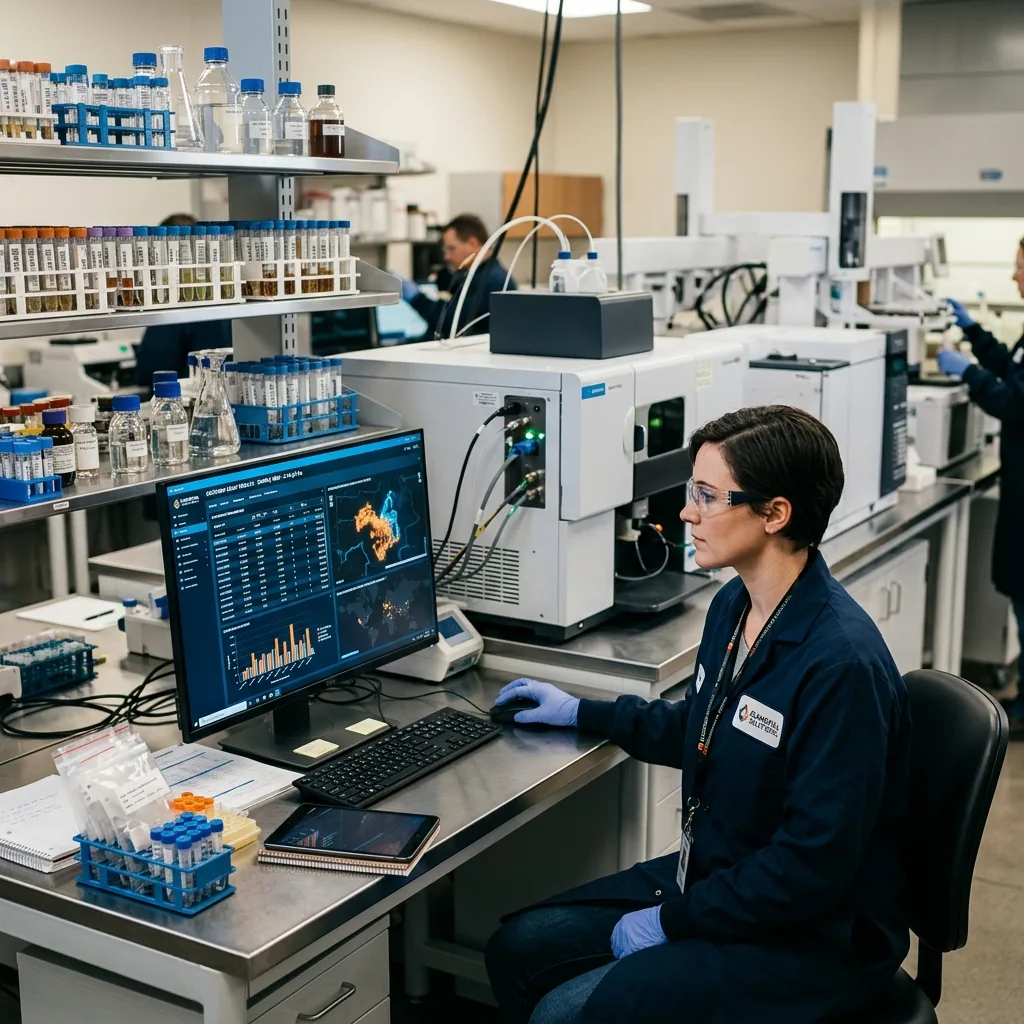
Why Controlled Documents Underpin Every Assay Result
In the high-precision environment of assay laboratories, the integrity of the final result is only as reliable as the documentation supporting the analytical process. ISO 17025 compliance requires that all technical methods, standard operating procedures (SOPs), and quality manuals be strictly controlled to prevent the use of obsolete versions. In a mining context, where sample volumes are massive and throughput is critical, the risk of a technician applying an outdated digestion method or an incorrect calibration curve can lead to significant errors in grade estimation, directly impacting the economic valuation of the mineral resource. In the OnLIMS family this is the job of OnQMS, the accreditation-evidence module: a separate module of OnLIMS, licensed apart from the core package and working only with OnLIMS, that holds these controlled documents and ensures that the transition from a physical manual to a digital workflow does not compromise compliance.
Technical compliance involves more than just storing a PDF; it requires a systemic approach to versioning, authorization, and accessibility. By keeping document control on the same server and database as the laboratory data, assay supervisors can ensure that every step—from sample preparation to final analysis—is performed according to the most current, authorized technical specification.
The Versioning Gap: Where Paper-Based SOPs Fail Audits
The primary challenge in manual document management within mining labs is the "versioning gap." When SOPs are printed and placed at workstations, there is a high probability that updated versions are not distributed simultaneously across all stations. This creates a scenario where different technicians may use different iterations of the same method, leading to inconsistent data. Furthermore, the requirement for "Page n of nn" pagination and explicit review dates is often neglected in manual systems, making it difficult for auditors to verify if a document is complete or current.
- Obsolete Method Application: The use of outdated assay methods due to poor distribution of revised SOPs, resulting in inaccurate geochemical data.
- Audit Trail Gaps: Difficulty in proving to assessors that a mechanism exists to check for revisions on a regular basis.
- Document Fragmentation: The lack of a centralized identifier for document copies, making it impossible to track the date of issue.
Version Control, Approval and Change History in OnQMS
OnQMS addresses these challenges by digitizing the document control lifecycle. Instead of relying on physical folders, each document moves through a strict version lifecycle: draft, under review, approved. When a new version of a technical method is approved, OnQMS marks the previous approved version as obsolete, so there is a single current, authorized version of each document for the technicians to work from. An approved version is frozen: any change creates a new version. This closes the "versioning gap": there is one current version, not several printed copies of different ages.
Furthermore, OnQMS supports the requirements of ISO 17025 by keeping the evidence around each controlled document: who approved each version and when, electronic signatures, and a tamper-evident change history. In the OnQMS ISO/IEC 17025 coverage view, those records sit under the clause they evidence, turning document control into an active component of the QA/QC strategy.
Faster Audits and Single-Version Data Integrity
Running document control in OnQMS, next to the OnLIMS data, yields measurable improvements in laboratory stability. First, it significantly reduces the time required for audit preparation; instead of manually searching for copy numbers, the quality manager can show the assessor the current version of each document, who approved it and its change history. Second, it improves the reliability of assay data by ensuring that 100% of the staff are operating under the same technical version.
In conclusion, achieving and maintaining ISO 17025 compliance in a high-throughput mining laboratory requires internal rigor backed up by a technical infrastructure that prevents human error. By replacing manual spreadsheets and paper-based SOPs with OnQMS working on top of OnLIMS, labs keep the traceability and version control of their procedures in one place. This digital transformation provides the internal confidence that every assay result is backed by a controlled, authorized, and current technical process.