A gold result leaves the laboratory as a single number on a certificate. Behind that number sit a jaw crusher, a splitter, a pulverizing bowl, a flux mix, a furnace, a cupel, an acid digestion and an instrument reading — each with its own way of quietly moving the answer. Fire assay remains the reference technique for gold and silver because it collects the precious metals from the whole test portion rather than extracting them from a surface. That same completeness is what makes it unforgiving: almost every failure mode happens upstream of the balance that finally weighs the prill.
What follows is the flow as it actually runs in a mine-site or commercial assay laboratory, with the points marked where control is either recorded or lost. Where OnLIMS modules are relevant they are named, but the sequence matters more than the software: a LIMS does not improve an assay, it makes the assay reconstructable.
Reception and Preparation: the Result Is Largely Decided Before the Furnace
The sample arrives as coarse material — drill core, reverse circulation chips, channel samples, mill products, concentrate. It is dried, crushed, split, pulverized to a target mesh, and a screen check confirms that the pulverizing actually reached that mesh. Only then is a charge weighed for fusion. Every one of these operations changes the mass, the particle size and the identity of what will eventually be assayed.
Two pre-analytical risks dominate. The first is cross-contamination: carryover in a crusher jaw or a pulverizing bowl after a high-grade sample, insufficient cleaning between samples, barren-quartz wash cycles skipped when the queue is long. Gold is the worst possible analyte for this, because a trace of carryover from a high-grade pulp is enough to lift a low-grade sample above a cut-off. The second is subsampling bias. Gold is frequently coarse and unevenly distributed, so reducing mass without reducing particle size first is how a laboratory produces a result that is precise, defensible in method terms, and simply not representative of the lot.
This is why traceability has to start here and not at the furnace. The record needs to carry the identity chain — original sample, coarse reject, pulp, assay charge — together with who prepared it, on which line and equipment, in which preparation batch, when the equipment was last cleaned, and what the screen check returned. OnLAB manages that part: registration and labeling on reception, custody handovers, preparation states, batch composition, and the storage location of rejects and pulps, which is what makes a re-assay or an umpire sample retrievable months later. When a client later disputes a grade, the argument is almost never about the instrument; it is about the pulp.
Fusion and Cupellation: the Variables That Make a Result Defensible
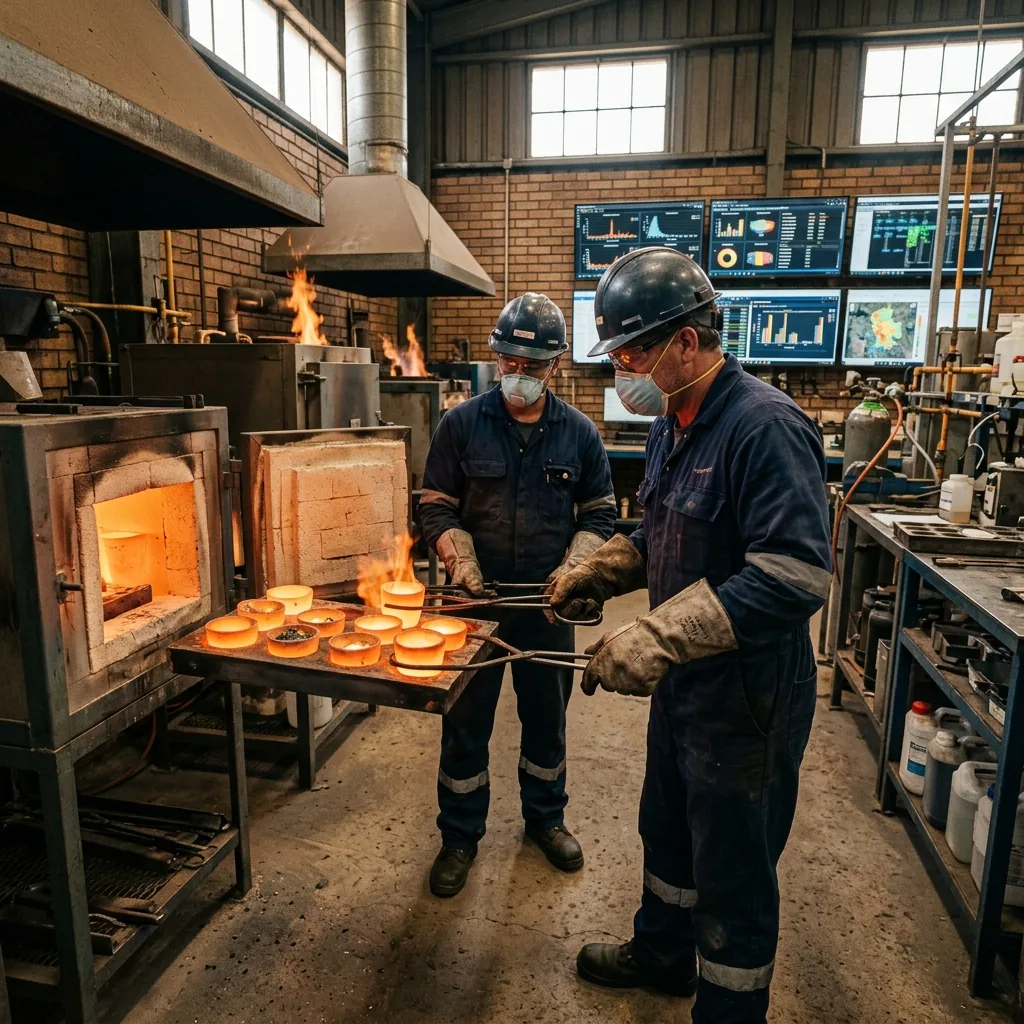
The weighed charge is mixed with flux — litharge, borax, silica, soda ash, with a reductant or oxidant adjusted to the sample's own chemistry — and fused in a crucible. The lead produced by the reduction of litharge collects the gold and silver as it settles, and the melt is poured so that slag and lead separate. The cooled lead button is hammered clean and cupelled in the muffle, where lead oxide is absorbed by the bone-ash or magnesia cupel and the precious metals remain as a doré bead. From there the finish is either gravimetric or, more commonly for low grades, a digestion followed by an instrument reading.
Fire assay is not a fixed recipe. Flux is adjusted per sample type, sulphide-bearing material behaves differently from oxide, and the assayer reads the slag and the button to decide whether the fusion worked. That flexibility is exactly why the variables have to be recorded rather than remembered. At minimum: charge mass, flux formulation and reagent lots (litharge in particular), crucible batch, furnace identifier, tray or rack and the position within it, fusion temperature and cycle time, cupel lot and cupellation conditions, button mass, prill mass, analyst and shift.
None of this is bureaucracy. When a tray comes back wrong, the useful questions are all of that form — which furnace, which position in the tray, which litharge lot, which cupel batch, which shift — and they can only be answered if the values were captured at the time the tray ran. A laboratory that records only the final grade has no way to distinguish a bad sample from a bad furnace zone. OnLAB carries the batch and tray structure, including position, so that a pattern along a tray is visible as a pattern rather than as scattered outliers; OnWSH captures button and prill masses directly from the assay balances instead of via a transcription step.
Digestion and Reading: the Calculation Belongs in the System
For a gravimetric finish, the doré bead is parted and the gold weighed directly. For an instrumental finish, the prill is digested — typically in nitric and then aqua regia — brought to a defined volume, and read by AAS or ICP-OES against a calibration curve prepared from standards, with reagent blanks and, where the range requires it, a further dilution and a re-read.
The final grade is therefore not measured; it is computed. It depends on the charge mass actually weighed, the digestion volume, every dilution factor applied, the blank correction, the calibration curve in force at the moment of the reading, and the detection and quantitation limits that determine whether a low value is reported as a number or as a less-than. Each of those inputs is a place where a result can be wrong without looking wrong.
This is the strongest practical argument against keeping the calculation in a spreadsheet. A spreadsheet formula has no version, no owner and no audit trail; a copied column carries a stale dilution factor without complaint; and the file that produced a certificate three years ago is rarely the file that exists today. The calculation has to live where the method version, the charge mass and the raw instrument output live together. OnWSH covers that side: instrument parsers for AAS and ICP-OES, balance capture, and calculations bound to the method and its revision, so that the reported grade can be rebuilt from its inputs rather than trusted on the basis of a number in a cell.
QA/QC of the Tray: CRMs, Pulp Duplicates, Blanks and What Happens When It Fails
Fire assay QA/QC is organized by tray, because the tray is the unit that shares a furnace, a flux batch and a run. A control scheme inserts certified reference materials chosen to match the matrix and the expected grade range, pulp duplicates that measure analytical repeatability, preparation duplicates taken further upstream that measure the preparation and subsampling error, and blanks — barren material carried through the full process — that expose contamination and carryover. Many laboratories add their own in-house control pulp for continuity between CRM lots.
The acceptance rules have to exist before the tray runs, not after the numbers are visible. CRM results are assessed against the certified value and its control limits, ideally on a control chart so that a slow drift is caught before a single dramatic failure; duplicates are assessed on a precision criterion appropriate to the grade; blanks against a defined threshold tied to the detection limit. The point of writing the rules first is that it removes the temptation to decide what counts as acceptable once you already know the answer.
When a tray fails, the correct action is to re-assay — the tray, or the identified span of it — and to record why. What must never happen is a number being adjusted to bring a control into line. That habit is the single most damaging practice in an assay laboratory: it converts a recoverable process failure into an undetectable data failure, and it is precisely what an ISO/IEC 17025 assessment, or a commercial dispute, is designed to find. The failed result and the repeat result should both survive, linked, with the decision, the reason and the person who made it. OnQC is built for that decision point: control charts and duplicate precision analysis, acceptance rules applied to the batch rather than to isolated samples, and a release block that holds affected results until the QA/QC decision is made and recorded.
From Result to Certificate — and to the Reconstruction Years Later
The last stage looks administrative and is not. Results are reviewed by the analyst, validated technically, approved by an authorized signatory and issued as a certificate that states the method and its revision. Corrections after issue are handled as a new, traceable revision of the certificate, never as a silent overwrite of the previous one. Access afterwards should be read access: geology, metallurgy, planning and commercial teams need the numbers continuously, and they need them without holding write permissions on the laboratory record. That is the role LabData plays alongside OnLAB.
The reason to invest in this stage is that the certificate will be questioned later, and rarely on the day it is issued. Grade reconciliation between the laboratory, the mill and the resource model raises questions months afterwards. Commercial settlements, umpire assays and shipment disputes reopen individual samples. An accreditation assessment asks how a specific result was produced, and expects the answer to be evidence rather than recollection. What has to be reconstructable is the whole chain: preparation batch and equipment, screen check, reagent and cupel lots, furnace and tray position, charge mass, raw instrument file, calibration in force, the QA/QC results for that tray, the re-assay decisions, and who approved the certificate and when.
The surrounding management-system evidence belongs with it — method documents and revisions, personnel competence and authorization, equipment calibration and maintenance, nonconformities and corrective actions — which is the ground OnQMS covers for laboratories working to ISO/IEC 17025. Fire assay is a mature technique and a well-understood one; what it demands is not novelty but discipline in recording what was actually done. A laboratory that can rebuild a two-year-old gold result from its own records does not have to win the argument. It only has to open the record.