1. Introduction
Titration is sometimes treated as a mature bench technique: reliable, familiar and simple enough to sit outside the main digital modernization conversation. In mining and chemical laboratories, that assumption creates a hidden data integrity risk. A titration result is not only an endpoint or a volume. It is the product of sample identity, mass or volume preparation, titrant standardization, endpoint detection, blank correction, dilution factors, analyst review, quality control and batch approval.
Modern laboratories often invest heavily in ICP, XRF, AAS, fire assay automation and dashboard visibility. Those investments are important, but wet chemistry still carries operational decisions in many sites: major-element determinations, acid-base control, redox procedures, environmental measurements, process control checks and confirmatory methods. The risk is not usually the titrator itself. The risk sits in the handoffs around it: manual transcription, spreadsheet formulas, uncontrolled corrections, undocumented recalculation and weak linkage between the final value and the evidence that produced it.
A Mining Laboratory LIMS must therefore manage titration as a controlled analytical workflow, not as an isolated result field. The objective is to preserve defensible evidence from endpoint to audit trail.
2. Why titration still matters
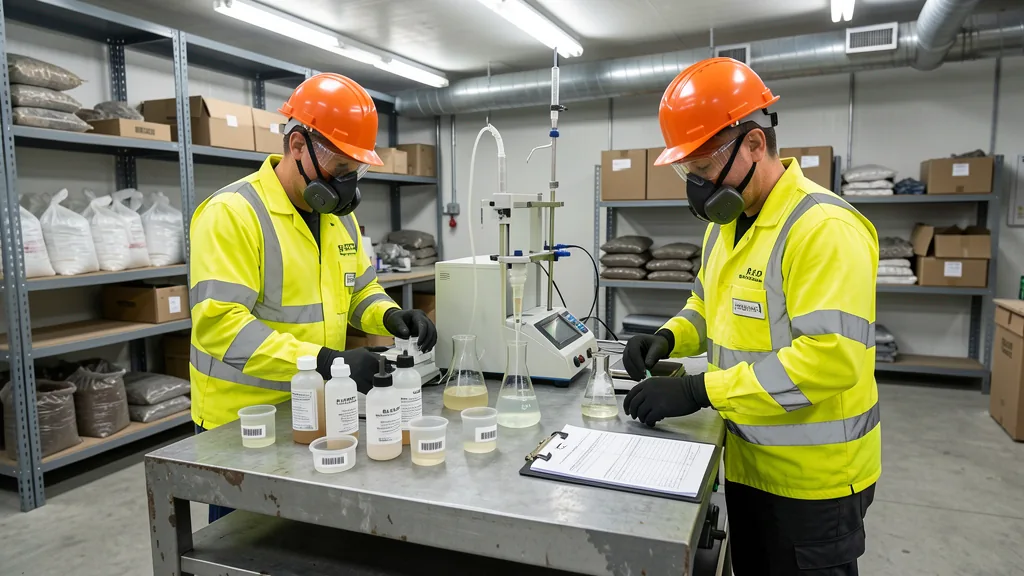
In mining and industrial chemistry, titration remains useful precisely because it is practical, robust and directly connected to wet-chemistry method control. Laboratories use titrimetric workflows where the matrix, concentration range or operating requirement makes a bench method appropriate: pH and alkalinity control, redox reactions, acid consumption, moisture-related corrections, process solutions, environmental checks and specialized determinations that complement instrumental techniques.
The apparent simplicity of the technique can hide a dense evidence chain. Before a result can be trusted, the laboratory must know which sample was tested, whether the preparation stage was valid, which titrant factor applied, whether the endpoint was accepted, whether blanks or corrections were used, whether replicate precision was acceptable, whether the CRM or control sample passed, and whether the batch was approved before reporting.
This is the same reason titration belongs inside the same controlled data environment as ICP, XRF, AAS, balances and fire assay workflows. The laboratory does not only need the final number. It needs the defensible path to that number.
3. The operational failure mode: small data outside governance
Large analytical platforms usually receive attention because their files are complex and their throughput is high. Titration data often travels through smaller channels: RS232 output, CSV files, local software exports, handwritten worksheets or spreadsheets. Those channels may look harmless, but they can carry high-value decisions.
Common weak points include retyping endpoint volumes, applying correction factors in uncontrolled spreadsheets, using outdated titrant standardization values, separating the instrument printout from the sample record, approving a final value without preserving the raw output, and releasing certificates without a clear link between the wet-chemistry calculation and the QA/QC checks applied to the batch.
For an ISO 17025-oriented laboratory, that is not a cosmetic issue. Technical records must show what was done, by whom, with which equipment, under which method, using which calculations and under which review path. If the titration result cannot be reconstructed, the reported value is weaker than it appears.
4. What a LIMS-controlled titration workflow should capture
A controlled workflow begins before the titrator produces a value. The sample must enter the laboratory lifecycle with a clear identity, custody state and analytical assignment. Preparation information, sample mass or volume, digestion or dilution steps, method selection and analyst responsibility must be attached to the worksheet or batch context.
At the instrument layer, the LIMS should capture the raw output produced by the titrator or titration software. Depending on the site, that may arrive through direct serial communication, TCP/file transfer, CSV/ASCII export or a vendor-specific output format. The important point is not the transport alone; it is the preservation of the instrument-derived value as evidence, with enough metadata to connect it to sample, method, instrument and worksheet parameter.
At the calculation layer, endpoint volume, titrant concentration, factor, blank correction, dilution factor, sample mass and method-specific constants must be applied in a controlled worksheet. The formula should not live only in a private spreadsheet. It should be versioned, reviewable and consistent with the method used by the laboratory.
At the quality layer, blanks, standards, CRMs, duplicates, replicates and control limits must be evaluated before release. Failed checks should create a visible review condition, not a silent warning that disappears after the result is copied somewhere else.
5. How OnLIMS fits the bench reality
OnLIMS is built for exactly this kind of laboratory reality: the point where instruments, worksheets, QA/QC rules and approval controls meet. In the OnLIMS architecture, OnLab manages the sample lifecycle, OnWsh provides the electronic worksheet environment, and OnQC enforces quality-control interpretation across batches and analytical workflows.
For titration workflows, OnLIMS can capture values from titrators through direct serial communication or file/TCP-based integration, depending on the site and instrument configuration. Families such as Metrohm Titrino/Titrando and Dosimat-style systems are representative of the type of wet-chemistry equipment that must be brought under controlled data capture rather than treated as an external bench island.
Once captured, titration outputs can be mapped into worksheet parameters. The worksheet layer supports real-time calculations, including stoichiometric formulas, absolute or relative references and method-specific transformations. This matters because the defensibility of a titration result often depends as much on the calculation context as on the endpoint itself.
OnLIMS also preserves raw instrument logs and data audit records, so the laboratory can trace what was imported, what was calculated, what was changed, who reviewed it and when the result moved through the lifecycle from pending to ready, approved and published.
6. QA/QC before publication
A titration workflow is not complete when the endpoint is detected. The laboratory still needs to decide whether the result is technically acceptable. OnLIMS supports that decision by placing titration data inside the same QA/QC discipline used for other analytical workflows: standards, blanks, duplicates, replicates, spikes, CRM/SRM validation, control charts and out-of-limit highlighting.
This changes the role of QA/QC from after-the-fact inspection to release control. If a duplicate is outside range, a CRM recovery fails or a blank correction indicates contamination, the batch should not simply continue toward reporting. The result must be reviewed, explained, corrected or rerun according to the laboratory method and quality system.
For mining operations, this matters because laboratory data drives decisions beyond the bench. Assay interpretation, metallurgical control, concentrate quality, environmental compliance and production reporting depend on values that can be defended under pressure. A LIMS-controlled titration workflow gives the laboratory a stronger basis for that defense.
7. Business value
Digitizing titration is not about making an old method look modern. It is about reducing the operational gap between a bench result and a defensible certificate. The immediate gains are fewer transcription errors, more consistent calculations, clearer analyst review, better batch visibility and faster identification of QA/QC failures.
The longer-term value is stronger laboratory memory. Instrument outputs, worksheet formulas, approval events, audit logs and QC decisions remain connected. When an auditor, plant metallurgist, environmental manager or customer asks how a value was produced, the laboratory can answer from the system rather than reconstructing events from paper, files and individual recollection.
In that sense, titration is a useful test of LIMS maturity. If the system can govern the small, messy, method-specific data of wet chemistry, it is much more likely to govern the broader laboratory operation with discipline.
8. Conclusion
Titration remains important in mining and chemical laboratories because it is practical, method-driven and closely tied to operational decisions. But its value depends on the quality of the evidence around it. Endpoint volume alone is not enough. A defensible result requires controlled sample identity, instrument capture, worksheet calculation, QA/QC validation, audit trail and accountable release.
OnLIMS treats titration as part of the laboratory evidence layer. By connecting titrators, electronic worksheets, QA/QC controls and approval workflows, it helps laboratories move from isolated bench measurements to traceable, ISO 17025-ready analytical records.