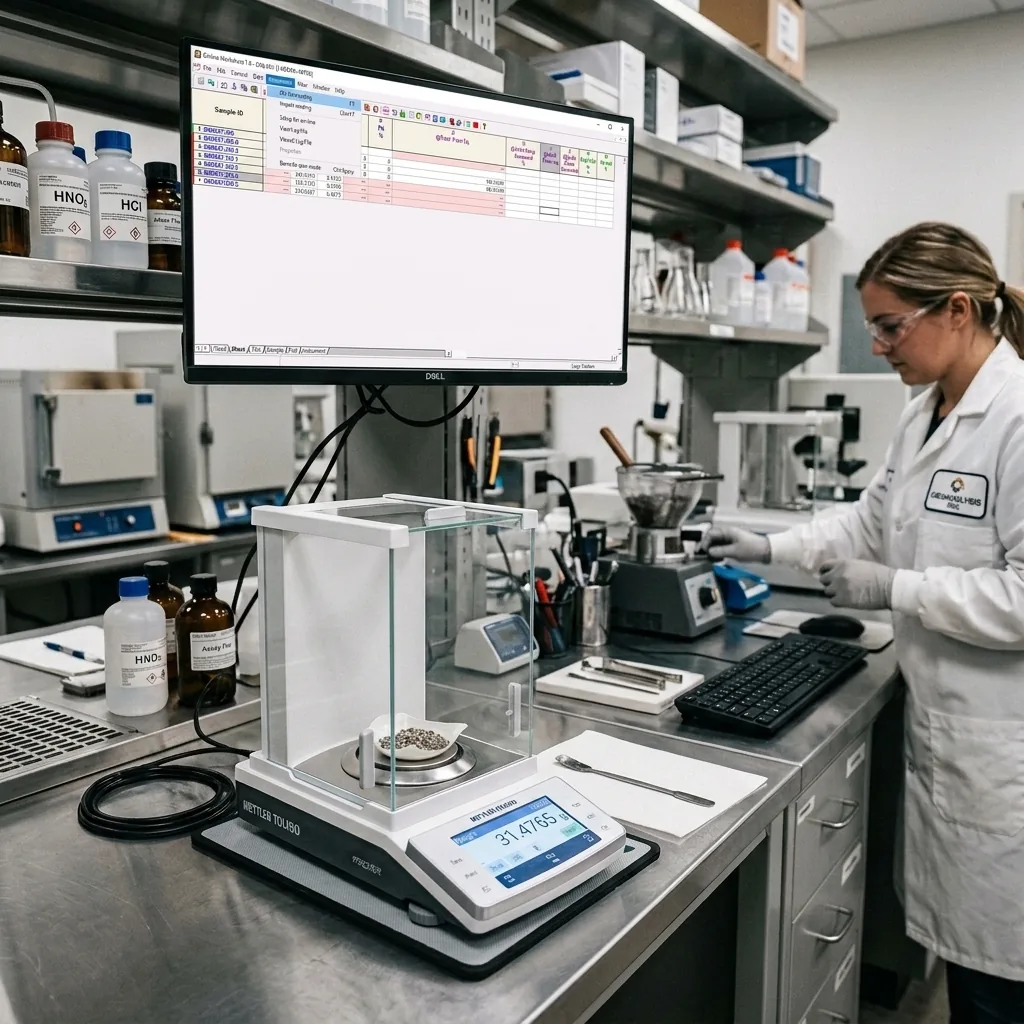
Why the Balance Is the First Line of Data Integrity
In modern mining laboratories, analytical balances are one of the most critical instruments within the entire geochemical workflow. From fire assay pulp preparation and moisture determination to reagent formulation and precious metal bead weighing, every analytical result begins with a weight measurement. Even a minimal transcription error during sample weighing can compromise assay accuracy, dilution calculations, QA/QC validation, and ultimately metallurgical decision-making across the processing plant.
Mining laboratories operating under ISO 17025 and NI 43-101 or JORC reporting standards require complete traceability of every analytical step. However, many laboratories still depend on technicians manually transferring balance readings into spreadsheets, paper logs, or disconnected systems. In high-throughput environments processing thousands of samples per day, these manual practices create operational bottlenecks and increase the risk of data contamination.
Mettler Toledo analytical balances are widely deployed across mining laboratories due to their precision, stability, and industrial reliability. Yet the true operational value emerges when these balances are directly integrated into a Mining LIMS environment capable of capturing measurements automatically at Level 0 instrumentation layer. By directly connecting RS232 or TCP/IP analytical balances into OnLIMS, mining laboratories establish a fully auditable and automated weighing process that protects data integrity from the very first analytical stage.
Direct integration becomes especially important during fire assay preparation, multi-acid digestion workflows, lithium borate fusion processes, and QA/QC control sample preparation where weighing precision directly impacts final ICP-OES, ICP-MS, or AAS analytical performance.
How Manual Weighing Cascades Into Assay Errors
Mining laboratories frequently process hundreds of pulverized ore samples per shift. During fire assay preparation, technicians must weigh pulp aliquots, flux mixtures, silver collectors, and calibration standards with extreme precision. In traditional laboratory environments, balance readings are manually copied into worksheets or spreadsheets before being entered into the LIMS. This creates multiple opportunities for transcription mistakes, decimal placement errors, or accidental sample mismatches.
Operational complexity increases further in laboratories running simultaneous digestion campaigns, duplicate pulps, umpire samples, and CRM validation programs. A single incorrect weight entry can cascade through dilution factors, moisture corrections, and analytical calculations, ultimately generating incorrect Au, Ag, Cu, or multi-element assay values. These issues often remain hidden until QA/QC failures appear in Shewhart charts or Thompson-Howarth duplicate plots.
Another major challenge involves concurrent technician activity. Multiple chemists may attempt to access or edit the same worksheet during high production periods, increasing the risk of overwritten values or data conflicts. In remote mining operations with unstable internet connectivity, cloud-dependent systems can also interrupt weighing workflows, causing delays and forcing technicians back into manual recording procedures.
- Challenge 1: Manual transcription of Mettler Toledo balance readings introduces data integrity risks, decimal errors, and sample mismatches during fire assay and digestion workflows.
- Challenge 2: Concurrent worksheet editing and unstable mine-site connectivity can compromise traceability, QA/QC validation, and operational continuity.
Direct Mettler Toledo Capture with OnLIMS
OnLIMS addresses these operational risks through direct Level 0 integration with Mettler Toledo analytical balances using RS232 or TCP-IP communication protocols. Weight readings are automatically captured directly from the balance into the SQL database without manual intervention. This eliminates spreadsheet dependency and prevents transcription errors at the source of the analytical process.
The OnLIMS sample loading engine automatically maps balance measurements to the correct worksheet rows, preserving chain-of-custody integrity throughout fire assay, digestion, and fusion operations. Calculations related to moisture loss, dilution factors, flux ratios, and analytical corrections execute within protected calculation blocks, preventing accidental modification by laboratory personnel.
To prevent concurrent editing conflicts, OnLIMS applies exclusive worksheet locks through its internal document control architecture. When a chemist opens a batch for editing, the corresponding records are electronically locked, preventing overwrites or collisions from other users. This mechanism is especially critical during high-volume precious metal campaigns where multiple technicians operate simultaneously across preparation and analytical departments.
Integrated QA/QC validation logic continuously evaluates standards, blanks, and duplicates before worksheets can progress from pending to approved status. If CRM values exceed 3-sigma control limits or duplicate precision drifts beyond Thompson-Howarth acceptance thresholds, the system automatically blocks approval and forces audited justification procedures. Combined with immutable audit logs and resilient offline-capable architecture, OnLIMS ensures complete operational continuity even in remote mining environments with unstable satellite communications.
From Manual Weighing to a Traceable, Automated Workflow
Direct integration of Mettler Toledo analytical balances into OnLIMS transforms mining laboratory weighing operations from a manual administrative process into a fully automated and traceable QA/QC-controlled workflow. By eliminating transcription errors at the source, laboratories significantly improve analytical consistency across fire assay, digestion, fusion, and instrumental analysis operations.
The combination of direct Level 0 instrument capture, protected calculation logic, concurrent editing controls, and real-time QA/QC validation provides mining laboratories with stronger ISO 17025 compliance and defensible audit trails for NI 43-101 and JORC reporting. Laboratory managers gain real-time operational visibility into sample throughput, technician activity, and analytical bottlenecks while maintaining uninterrupted production continuity in remote mining environments.
For mining operations dependent on accurate metallurgical decision-making, automated balance integration reduces rework, minimizes reporting risks, improves turnaround times, and protects the integrity of the entire laboratory value chain. OnLIMS delivers the operational resilience and traceability required by modern high-throughput mining laboratories.