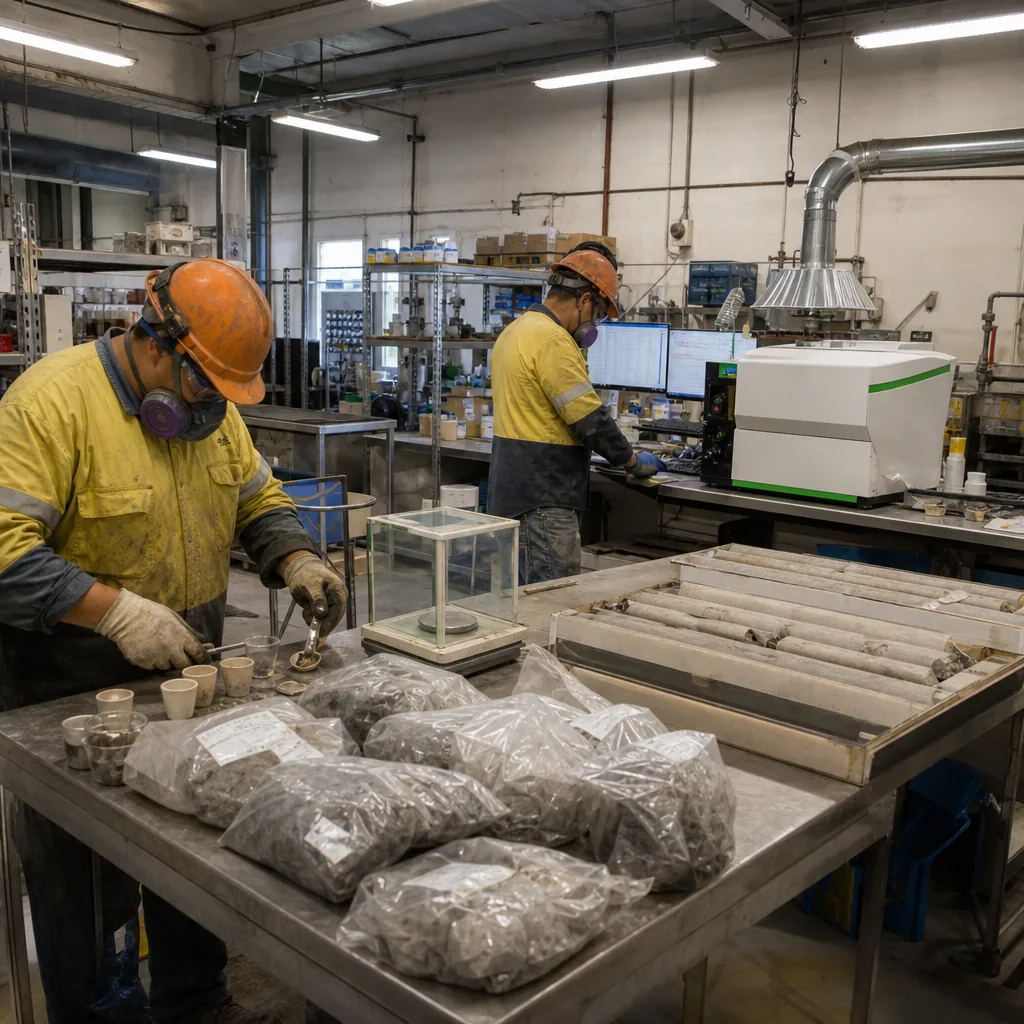
Inside the Tangled Software Stack of a Production Assay Lab
Mining laboratories rarely operate in clean, isolated software environments. Most production assay labs run on a combination of legacy databases, instrument files, spreadsheets, balance outputs, dispatch reports, and site-specific operational routines that have evolved over many years. These systems are not theoretical. They are part of the daily production chain: sample reception, fire assay batches, ICP or XRF result capture, QA/QC validation, certificate generation, and final reporting to geology, metallurgy, plant operations, or commercial teams.
For a high-throughput mine site laboratory, replacing that entire operational base is not always realistic. A production LIMS may contain years of historical samples, validated results, instrument mappings, user routines, custom reports, and audit dependencies. Any interruption can affect turnaround time, operational continuity, and the credibility of reported assays.
This is where the real challenge begins. Laboratory managers and QA/QC teams need stronger control, better traceability, and ISO 17025-ready audit evidence. At the same time, they cannot simply stop production, rewrite every workflow, or expose critical laboratory data to external cloud dependencies.
OnLIMS addresses this situation through a practical architecture: SQL Shadowing. Instead of forcing a disruptive replacement of the transactional system, OnLIMS can extract and structure quality-related information from existing SQL Server databases while production continues. The result is a modern quality management and audit layer built around the reality of mining laboratory operations, not around generic laboratory software assumptions.
When Defensible Traceability Lives Scattered Across Legacy Systems
ISO 17025 compliance requires more than having results stored in a database. It requires defensible traceability. A laboratory must be able to demonstrate who performed each action, when results were produced, how QA/QC materials were applied, whether control limits were respected, and how non-conforming results were handled.
In mining laboratories, this becomes complex because operational data is often distributed across multiple sources. A fire assay batch may involve sample login, weighing, fusion, cupellation, gravimetric finish, CRM insertion, duplicate handling, and final reporting. An ICP workflow may involve digestion, aliquots, instrument result files, calibration checks, and data review. XRF or PGNAA integrations may introduce additional data streams. Each stage produces information that must remain traceable.
The problem is not only technical. It is operational. Legacy systems are often stable precisely because they have been adapted to the site over many years. They may contain business rules that are not fully documented outside the database. They may also support specific reporting formats, sample numbering conventions, or instrument interfaces that are already embedded in daily work.
- Production dependency: the laboratory cannot pause daily assay processing while a new quality layer is implemented.
- Historical data complexity: years of sample records, QA/QC history, dispatch reports, and instrument outputs must remain available.
- Audit fragmentation: quality evidence may exist, but it is not always organized in a format suitable for modern ISO 17025 review.
- Operational risk: replacing a stable transactional database can create more risk than value if the goal is specifically compliance visibility.
- Manual reconciliation: when QA/QC data is extracted manually, the laboratory increases the probability of transcription errors, inconsistent reports, and weak audit defensibility.
For mining operations, the correct question is not always “How do we replace the system?” Sometimes the better question is: “How do we expose, validate, and control the quality data already inside the production system without interrupting it?”
SQL Shadowing: Reading the Production Database Without Touching It
SQL Shadowing is OnLIMS’ non-invasive method for extracting quality and operational data from legacy transactional databases while allowing the production system to continue running. It creates a parallel quality and reporting layer that reads from the existing SQL Server environment without forcing laboratory staff to abandon the workflows already supporting daily operations.
This architecture is especially relevant for mine sites where the laboratory system is mission-critical. The production database remains the operational source for sample flow, result entry, instrument integration, and reporting. The shadow layer focuses on structured visibility: QA/QC review, audit trails, historical quality records, control charts, and compliance evidence.
- CRM, blank, and duplicate tracking: historical batches can be reviewed with their quality controls intact.
- Shewhart control charts: LCL/UCL limits can be enforced and reviewed over time.
- Duplicate precision: Thompson-Howarth analysis can be applied to detect precision drift.
- Non-conformance review: patterns can be identified, retained, and prepared for retrospective audits.
- ISO 17025 evidence: audit material can be organized without forcing a risky database migration.
The value is not only in reading data. The value is in making the data operationally usable for quality control. A SQL table by itself is not a quality system. A laboratory needs context: sample identity, batch structure, method, instrument, analyst, QC type, expected value, observed value, control limits, validation status, and final reporting condition.
OnLIMS translates that operational data into quality intelligence. It allows QA/QC teams to inspect whether a batch respected control limits, whether duplicates behaved within expected precision, whether blanks indicate contamination risk, and whether results should be released, reviewed, or held.
Turning ISO 17025 from a Document Problem into an Operational Data Problem
ISO 17025 accreditation depends on repeatability, traceability, documented control, and defensible evidence. In a mining laboratory, this evidence must survive operational pressure: high sample volumes, urgent dispatch requirements, instrument maintenance windows, re-assays, duplicate checks, and exceptions triggered by QA/QC failures.
A weak quality system creates risk in several ways. Results may be technically present in the database but difficult to reconstruct during an audit. QC failures may be reviewed inconsistently. Historical patterns may remain hidden until they become production issues. Manual exports may introduce errors. Audit preparation may depend too heavily on individual staff knowledge instead of systemized evidence.
OnLIMS reduces that risk by structuring quality information directly around mining laboratory workflows. Instead of treating ISO 17025 as a document storage problem, it treats compliance as an operational data problem.
For example, a QA/QC manager preparing for an audit should not need to manually reconstruct the relationship between a sample batch, its CRMs, its blanks, its duplicates, its analyst, its instrument output, and the final reported result. That relationship should be available through the system. The same applies to historical control charts, non-conformance records, and batch hold decisions.
SQL Shadowing makes this possible even when the underlying transactional system is legacy. It provides a controlled pathway from operational data to audit-ready quality evidence.
A Controlled Middle Path Between Doing Nothing and Ripping It Out
The strongest advantage of SQL Shadowing is that it separates quality modernization from production interruption. A laboratory can improve audit visibility, QA/QC control, and historical reporting without immediately replacing the entire operational database. This reduces implementation risk and allows the site to modernize in stages.
The business value is clear:
- Lower migration risk: legacy production workflows remain active while quality visibility improves.
- Better audit readiness: ISO 17025 evidence becomes easier to retrieve, review, and defend.
- Improved QA/QC discipline: CRMs, blanks, duplicates, control limits, and precision checks become more visible.
- Reduced manual work: QA/QC teams spend less time reconstructing evidence from exports and spreadsheets.
- Stronger continuity: modernization does not require stopping the laboratory or exposing data to cloud dependency.
- Better long-term governance: historical quality records remain available for retrospective analysis.
For mining laboratories, this is a practical path between two extremes. On one side is the risk of doing nothing and leaving quality evidence fragmented. On the other side is the risk of attempting a disruptive full replacement before the operation is ready.
OnLIMS SQL Shadowing offers a controlled middle path: preserve the production system, extract the quality data that matters, and build a modern QMS and ISO 17025 audit layer around it.
That is the core principle behind OnLIMS as a Mining Laboratory LIMS specialist. The system is not designed for generic laboratory theory. It is designed for the operational reality of mine site laboratories, where continuity, traceability, QA/QC discipline, and data sovereignty are not optional.