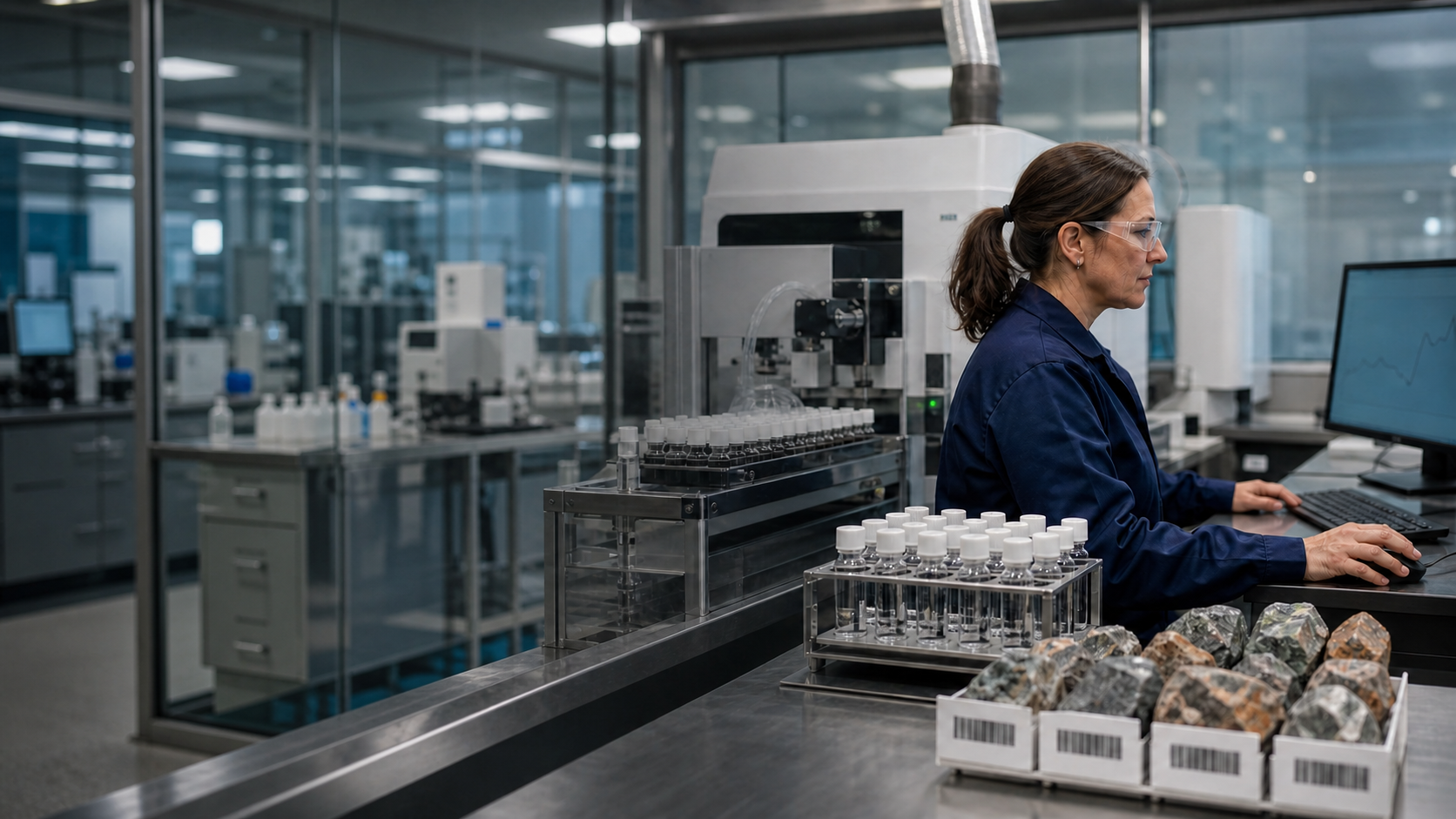
OnLAB, OnWSH, OnQC and LabData preserve the sample context across specialized operational views.
A mining laboratory does not operate as a single software screen. A sample moves through reception, preparation, analytical instruments, quality-control decisions, approval, reporting and access by people outside the laboratory. Each handoff can preserve control—or create another opportunity for transcription errors, missing context and untraceable decisions.
That is why OnLIMS is structured as a suite of connected industrial applications rather than a generic database with one interface. OnLAB, OnWSH, OnQC and LabData each provide a specialized operational view, but they are not isolated products or data silos.
The distinction matters. An analyst working in OnWSH can see the relevant QC information and reports without opening every other application as a separate step. From a report, an authorized user can navigate back to the worksheet behind the reported result. The user follows the sample and its context—not the boundaries between software modules.
The value is therefore not simply that four applications exist. It is that they preserve one connected operational record from sample login to Certificate of Analysis, including sample identity, instrument data, calculations, QA/QC status, approvals and audit history.
Layer 1 — OnLAB establishes the sample record and chain of custody
The workflow starts in OnLAB, the central data backbone. It manages the sample lifecycle from initial geological or production logging through final reporting.
For exploration work, this may mean a batch of drill-core samples, each with a unique identity and requested analytical package. For a metallurgical plant laboratory, it may mean routine samples collected repeatedly from fixed process points and differentiated by date and time.
OnLAB keeps those different operating models inside a controlled workflow. Sample states progress through defined stages such as Pending, Ready, Approved and Published. The system retains a field-level audit trail and supports barcode-based identification, technical reports and customizable Certificates of Analysis.
OnLAB establishes the governing record, but users do not need to return to it for every operational question. The same sample, job and status context is available to the connected applications that perform worksheet capture, QC evaluation, reporting and controlled stakeholder access.
This is the first operational control: every result must remain attached to the correct sample, request, method and workflow state.
Explore OnLIMS sample tracking
Layer 2 — OnWSH captures results where the analysis happens
Once a sample reaches the analytical bench, OnWSH becomes the working layer between analysts and instruments. It is more than a data-entry endpoint: it brings the worksheet, analytical context, QC visibility and related reporting into the analyst's working view.
OnWSH supports direct serial capture and configurable file-based imports from analytical equipment. The OnLIMS product catalogue documents connectivity across more than 150 instruments, including ICP-OES and ICP-MS platforms, AAS systems, XRF analyzers, LECO carbon and sulfur instruments, analytical balances, titrators and UV-Vis equipment.
This removes a critical break in many laboratory workflows: reading a value from an instrument, typing it into a spreadsheet and then transferring it again into another system.
Result capture can apply configured calculations such as dilution or moisture factors, detection limits and formula-driven transformations. Out-of-range values can trigger an interactive warning and require a digital justification before acceptance.
The objective is not automation for its own sake. It is to preserve the connection between the instrument output, the analyst action and the controlled sample record. Because relevant QCs and reports can be viewed from OnWSH, the analyst does not need to export data or repeatedly switch applications simply to understand whether the work is complete and under control.
See OnLIMS instrument integration
Layer 3 — OnQC controls the decision to accept or reject
A captured result is not automatically a defensible result. OnQC provides the specialized statistical QA/QC environment used to evaluate standards, blanks and duplicates before analytical work is released. Its controls remain connected to the worksheet where results are captured: QC status can be interpreted in OnWSH as data arrives, while OnQC provides the deeper control-chart and validation view when required.
Its documented controls include Shewhart, X-Control, CUSUM and Thompson-Howarth charts, along with duplicate range and precision plots. Certified Reference Materials and blanks can be tracked as part of the same validation process.
When a limit violation occurs, the workflow does not need to disappear into an email, a spreadsheet comment or an undocumented verbal decision. The analyst can be required to enter a traceable justification before the affected batch is released.
This is the difference between displaying a result and controlling the decision around that result. The QA/QC record stays connected to the sample, analytical batch and final approval status. A supervisor reviewing an exception can evaluate it in context rather than reconstructing the event from a worksheet export, a separate chart and an email explanation.
Review OnLIMS QA/QC management
Layer 4 — LabData gives stakeholders controlled access
After results are finalized, laboratory personnel often become an information bottleneck. Geologists, plant managers and external clients request sample status, historical results or finalized reports, generating repeated emails and manual exports.
LabData provides read-only stakeholder access without exposing the operational interfaces used to process and approve laboratory work. Authorized users can track samples, download finalized results and review historical assays. Field or production sites can also submit batches remotely through a controlled portal.
This is another connected view of the same record—not a secondary database populated after the fact. A request submitted through LabData can enter the laboratory workflow as the job the laboratory processes, while published results and reports become available to the authorized stakeholder without another transcription or redistribution step.
This separates operational authority from information access. More people can use laboratory data without receiving permission to alter the analytical workflow.
The commercial model reinforces that separation. OnLIMS documents unlimited management-user access for OnLAB and LabData, while active instrument-facing applications are licensed per connected instrument. A laboratory can therefore extend visibility to geologists, operators and managers without turning every additional viewer into another seat-license decision.
Explore the complete OnLIMS product suite
Connected navigation follows the evidence in both directions
The four applications answer different operational questions:
- OnLAB: What is this sample, where is it in the workflow and who changed its record?
- OnWSH: How did the analytical result enter the system and which calculations were applied?
- OnQC: Did the batch satisfy its configured quality controls, and how were exceptions justified?
- LabData: Who may see finalized information without changing laboratory operations?
Their connection goes beyond sharing one platform and database. OnLIMS also preserves the relationships users need while they work:
- from the sample or job to its worksheets;
- from OnWSH to the relevant QC status and reports;
- from captured results to the standards, blanks and duplicates used to evaluate them;
- from an approved report back to the worksheet that produced the reported data;
- from published results to controlled stakeholder access in LabData.
This creates bidirectional traceability. A laboratory can follow information forward from the instrument and worksheet to approval and reporting. It can also work backward from a reported value to the worksheet, analytical context and controls behind it.
That reverse path is especially important during technical review, exception investigation and audit preparation. The report is not a dead-end document, and the worksheet is not an isolated data-entry grid. Both remain part of the same evidentiary chain.
Because the applications expose the same connected record through role-appropriate views, the laboratory does not need to reconstruct the story from unrelated spreadsheets, instrument folders, QA/QC files and email attachments.
OnLIMS can also exchange approved information with corporate systems through configurable file or ODBC exports, including ERP and plant-historian environments. Certificates and production reports remain outputs of the controlled laboratory workflow rather than manually rebuilt documents.
Where OnQMS fits
OnQMS addresses a related but different requirement: organizing accreditation evidence against ISO/IEC 17025 clauses and applicable accreditation guidance. It should not be confused with the transactional sample workflow itself.
OnLIMS controls the operational sample and result lifecycle. OnQMS helps the laboratory retrieve the broader documentary and operational evidence needed when an assessor asks how a requirement is supported. Keeping those responsibilities explicit avoids presenting compliance as a checkbox or pretending that software makes an accreditation decision.
See OnQMS accreditation evidence
Evaluate the workflow with one real sample
A useful LIMS demonstration should not begin with a generic dashboard. It should begin with one representative sample from your operation and follow it through the exact control points that matter—including the navigation paths between applications:
- sample or batch creation;
- barcode and chain-of-custody events;
- worksheet and instrument capture;
- calculations and detection limits;
- QC visibility and reporting from the worksheet;
- standards, blanks and duplicate evaluation;
- exception justification and approval;
- Certificate of Analysis or production reporting;
- navigation from a reported result back to its worksheet;
- controlled access for laboratory stakeholders;
- export to the systems that consume approved results.
That walkthrough shows whether a platform fits the laboratory's real operating model—not merely whether it can display familiar fields.
Book a technical OnLIMS demonstration using one of your real laboratory workflows and your current instrument list.
Book a technical demonstration