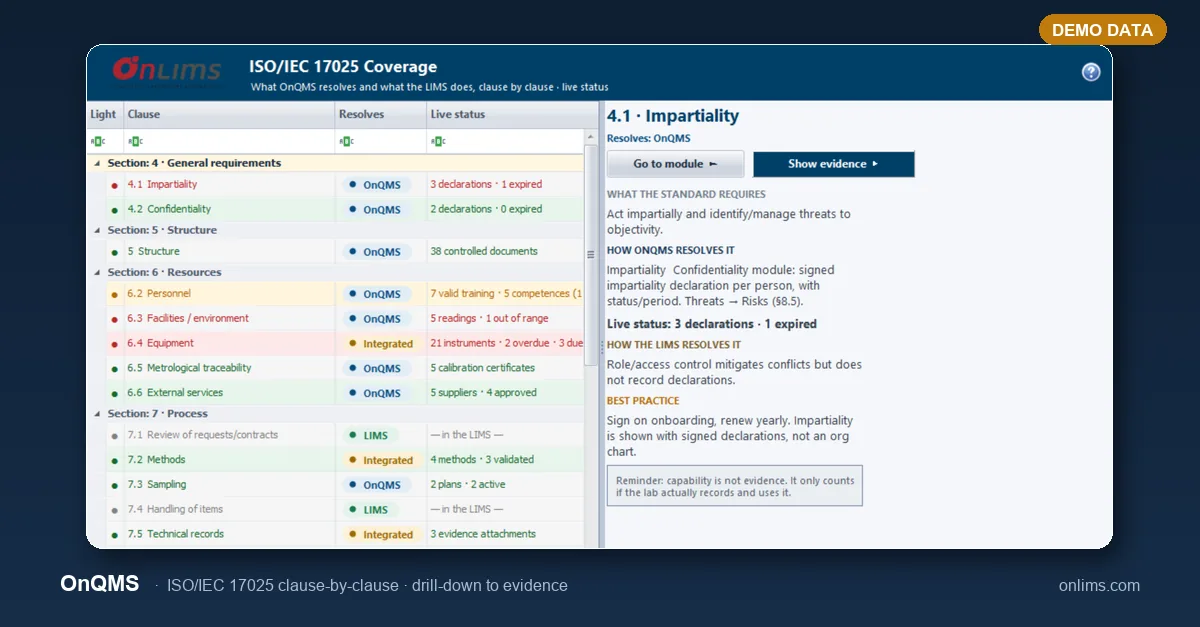
Actual OnQMS interface with demonstration data.
A Correct Result Can Still Be Difficult to Defend
A laboratory result may be technically correct and still not constitute sufficient evidence during an assessment. When an assessor selects a test and asks which procedure governed it, who was authorized to perform it, which equipment was used, whether its calibration was current and which controls supported the result, the answer is rarely found in a single record.
The result is in the LIMS. The procedure may be in a document repository. The analyst's competence is often maintained in a spreadsheet. Calibration certificates may reside in a network folder. Audits, nonconformities and corrective actions appear in separate systems.
The problem is not the absence of data. The problem is that the evidence chain must be reconstructed manually.
OnQMS was designed to close that gap within the OnLIMS environment: it reads the operational context already recorded by the laboratory, incorporates controlled quality records in its own data layer and organizes the complete set as navigable evidence for ISO/IEC 17025.
Data, Documents, Evidence and Accreditation Are Not the Same
A defensible quality architecture separates four concepts:
- Data: records what occurred operationally: sample receipt, test assignment, instrument use, results and workflow states.
- Documents: define or support the work: procedures, validations, certificates, plans, forms and approved revisions.
- Evidence: establishes the verifiable relationship among those records, their versions, responsible persons, equipment, signatures and dates.
- Accreditation: is the independent judgment of the accreditation body and its assessors.
A LIMS is particularly strong in the first layer. A traditional document management system focuses on the second. OnQMS builds the third by connecting operational and quality records. It deliberately does not intrude into the fourth.
This boundary is essential. The existence of a feature does not demonstrate that the laboratory used it correctly. A stored procedure does not prove that its current version governed a particular test. Training alone does not demonstrate that the analyst was authorized on the relevant date. Nor is a green indicator equivalent to a conformity decision if the reviewer cannot inspect the records that support it.
A Quality Satellite, Not a Second LIMS
OnQMS is a Windows application built for the same industrial environment as OnLIMS. It operates on the laboratory's infrastructure, uses Microsoft SQL Server and can function on the local network without a mandatory cloud dependency.
- OnLIMS remains the operational system of record. OnQMS reads the required context: tests, worksheets, instruments, users and quality-control definitions.
- OnQMS stores quality records in dedicated
QMS_*tables. Documents, competencies, calibrations, audits, risks, signatures and corrective actions remain separate from the LIMS transactional schema. - The evidence engine connects both layers. The quality team does not need to manually recreate every test, instrument or user in an isolated platform.
- The cockpit and reports expose the path. The user can start from a clause or test and drill down to the records supporting the displayed status.
This design makes it possible to add quality management without writing to the core sample-processing tables.
Two Paths for Inspecting the Evidence
1. Coverage by Clause
The cockpit represents clauses 4.1 through 8.9 of ISO/IEC 17025 and classifies the available evidence as present, partial, absent or insufficiently recorded. It also identifies whether the information comes from OnLIMS, OnQMS or both.
The important capability is not the indicator's color, but access to the detail. The quality manager can open a clause and review certificates, attachments, electronic signatures, audit findings and other associated records. If a gap exists, the system exposes it rather than hiding it within an aggregate percentage.
2. Evidence by Test
The second path answers an operational question: what supports this specific test? For each configured test, OnQMS can bring together seven observable dimensions:
- current, approved procedure;
- responsible person;
- authorized personnel;
- associated equipment and calibration status;
- method validation or verification records;
- related quality-control definition;
- date of the most recent evidence update.
The links account for versions. A signature applied to an obsolete revision does not count as evidence for the approved version that currently governs the work. This avoids a common false positive: confusing historical existence with current operational applicability.
More Than Document Storage
OnQMS maintains the records needed to sustain the chain, not only links to files. Its functional areas include:
- controlled documents, approved revisions and assignment to tests;
- personnel competence, training, assessments and certificates;
- equipment, calibrations, certificates and expiration alerts;
- method validation and verification;
- nonconformities, complaints and corrective actions;
- internal audits and findings linked to clauses;
- risks, opportunities, impartiality and confidentiality;
- scope of accreditation, environmental conditions and sampling plans;
- suppliers, record retention and management review;
- proficiency-testing plans, CSV import and z-score charts by analyte;
- electronic signatures, attachments, PDF/XLSX exports and inspection package.
Proficiency testing illustrates the separation of responsibilities. OnQMS retains rounds, z-scores, ±2 and ±3 bands, reviews and follow-up. It does not replace the daily analytical control charts managed by OnLIMS. OnLIMS controls production QA/QC; OnQMS organizes accreditation evidence around quality activities.
One Base Standard, Several Local Contexts
ISO/IEC 17025 is international, but accreditation is administered through national and sector-specific systems. Bodies publish supplementary procedures on surveillance, proficiency testing, scope, retention, impartiality and renewal.
OnQMS models this reality through configurable Compliance Packs. The implementation includes a base ISO profile and country- or body-specific profiles for Peru, Chile, Bolivia, Mexico, Canada, the United States, Argentina and Spain. They are not presented as equivalent or universally complete.
Every automated local alert must retain a defensible source and a clear translation from the published rule to the software's behavior. If a body does not publish a numerical threshold, OnQMS does not turn an internal convention into a regulatory obligation. The system distinguishes among a published requirement, an internal policy, a technical recommendation and a field with no default rule.
Integrity Must Survive the Dashboard
Evidence is useful only if the system can explain who created, modified, reviewed or signed each record.
Electronic signatures require reauthentication against the laboratory identity managed by OnLIMS. The record retains who signed, what was signed, when it was signed, the meaning of the signature and a hash associated with the entity and its state.
The primary audit log is append-only and uses a SHA-256 hash chain. Each entry incorporates the previous hash, making it possible to verify continuity and detect a break. The correct term is tamper-evident: the chain helps reveal alterations, but does not claim that the entire infrastructure is impossible to compromise.
OnQMS also generates a PDF inspection package with quality records and a signature manifest. If a required signature is missing, the manifest states so; it does not manufacture an appearance of completeness.
AI Assistance Without Relinquishing Control
The platform includes a deterministic offline assistant and an optional conversational mode that is disabled by default. The laboratory can select a compatible local or cloud endpoint.
Retrieval starts from the evidence. If no controlled material exists to support the answer, the assistant states that the question is not covered. It does not declare conformity, invent evidence, approve records or replace the quality manager. If a local model is used, the interaction can remain within the laboratory network.
What OnQMS Does Not Claim
OnQMS is not a metrological calculation engine. It records measurement uncertainty and validation parameters, but does not automatically build uncertainty budgets or calculate LOD, LOQ, precision or accuracy. Nor does it independently detect daily out-of-control production events from worksheets: that execution belongs to OnLIMS.
More importantly, OnQMS does not accredit a laboratory, certify conformity, guarantee the outcome of an assessment or replace the assessor. It organizes the evidence that qualified people need to review, decide and defend.
The Practical Test: Answering an End-to-End Question
The value lies not in the number of modules, but in the ability to answer a precise question without reconstructing the laboratory's history.
Select a test. Open the current procedure. Identify the responsible person and authorized personnel. Verify the equipment and its calibration. Review method validation and proficiency testing. Follow findings to their quality records. Confirm signatures and change history. Finally, package the evidence without presenting a misleading image of completeness.
That is the operating model: OnLIMS preserves the laboratory record; OnQMS builds a navigable evidence chain around it; the accreditation body assesses the laboratory.
To strengthen the operational foundation first, see OnLIMS for ISO/IEC 17025. To review the complete evidence path with your own tests, scope and accreditation context, request a technical demonstration of OnQMS.