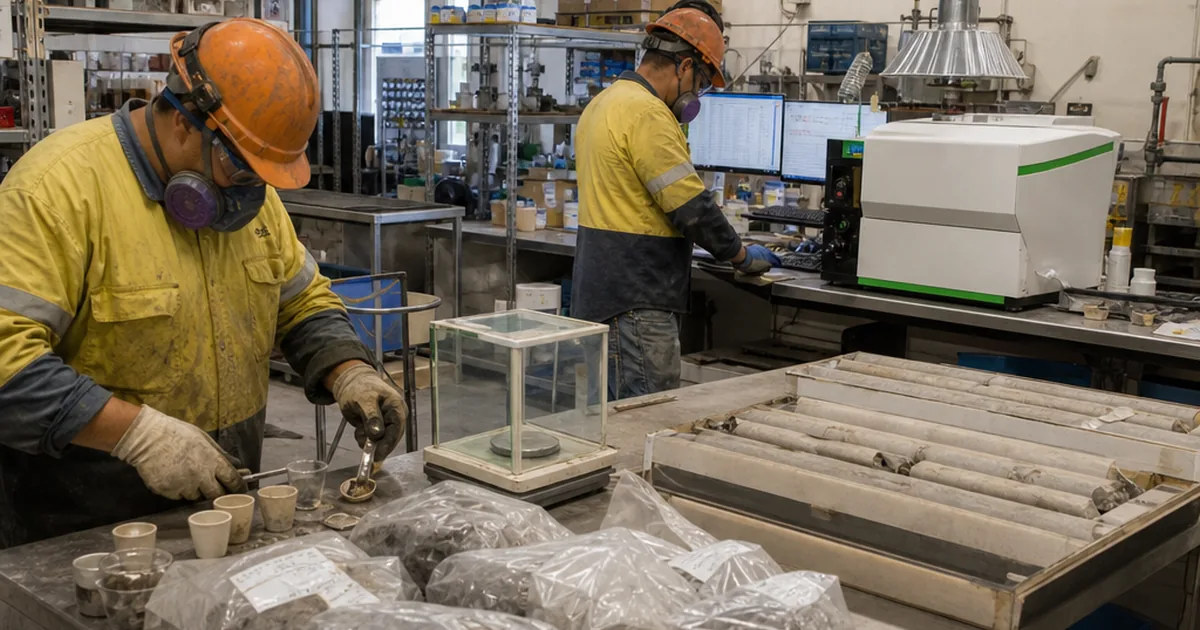
When Mining Labs Face Sample Surges, Control Matters More Than Speed
Mining laboratories are under constant pressure to process more samples, reduce turnaround time and support faster operational decisions. Exploration programs expand. Grade control campaigns intensify. Plant teams request quicker assay feedback. Metallurgical teams need reliable evidence to understand recovery, feed variability and process performance.
In that environment, high sample volume is not the problem. Uncontrolled sample volume is.
A mining laboratory can receive more samples, add shifts or push instruments harder, but if the laboratory loses traceability, quality control discipline or result validation, speed becomes a risk multiplier. The lab may appear faster on the surface while producing weaker operational evidence underneath.
That is why sample surges must be managed as a control problem, not only as a throughput problem.
The weak points appear under pressure
When sample volume rises quickly, the first failures are rarely theoretical. They show up in ordinary operational details:
- sample reception queues become unclear;
- preparation status is tracked manually or inconsistently;
- bottle roll, fire assay or screen fire assay workflows lose visibility;
- analytical balances and instruments generate result files that must be copied, renamed or transcribed by hand;
- blanks, duplicates and standards are reviewed too late;
- QC exceptions are discovered after reporting pressure has already increased;
- turnaround time is measured after the fact instead of managed while the work is moving.
These issues do not always stop the laboratory. Often, they create something more dangerous: a laboratory that continues operating while management has less confidence in the data trail.
For a mining operation, that matters. Assay results influence grade control, ore routing, metallurgical accounting, recovery monitoring, environmental evidence, client reporting and financial decisions. If the laboratory cannot prove how each result was received, prepared, measured, validated and reported, the operation carries hidden risk.
Throughput without traceability creates faster uncertainty
A high sample volume mining lab needs more than faster data entry. It needs a control architecture that preserves the identity, status and evidence history of each sample.
A mining LIMS should make it clear where each sample is, what work has been completed, which method applies, which instrument produced the result, which QC rules were triggered and who validated the final report.
That control layer becomes especially important when the laboratory receives a surge of samples from grade control, exploration drilling, plant troubleshooting or campaign sampling. During normal volume, manual workarounds can appear manageable. During pressure, those workarounds become bottlenecks.
The question is not only: can the lab process more samples?
The better question is: can the lab process more samples while keeping every critical event traceable, auditable and reviewable?
QA/QC must remain visible before reporting
Quality control in mining laboratories is not a document stored for audits. It is an operational discipline that must remain visible while work is happening.
Blanks, duplicates, certified reference materials, standards and method controls only protect the laboratory if exceptions are captured and reviewed before results are released. If QC signals are hidden in spreadsheets, disconnected instrument files or late manual checks, the laboratory may discover problems after the operational decision has already been made.
This is where a mining laboratory LIMS must protect assay data integrity. The system should help the laboratory see QC status, method context, instrument source and validation state before reporting, not after.
For ISO 17025 mining laboratory environments, this evidence trail is also central to defensibility. The laboratory needs to show not only the final number, but the controlled process behind the number.
Instrument integration is part of operational control
When sample volume increases, manual transcription becomes one of the most expensive forms of risk.
Analytical balances, ICP instruments, pXRF workflows and other laboratory systems produce data that must enter the laboratory record accurately. If operators must copy values between instrument software, files, spreadsheets and reports, the lab adds latency and error exposure exactly when production pressure is highest.
Instrument integration is not only an efficiency feature. It is part of control.
Direct or structured instrument data capture reduces manual handling, preserves source evidence, supports validation and gives supervisors a clearer view of what is happening in the laboratory. For mining operations, that helps protect both turnaround time and data confidence.
Turnaround time needs live visibility
Turnaround time is often discussed as a final metric: how long did it take to report the result?
But for laboratory managers, the more useful question is operational: where is the delay forming right now?
A mining LIMS should help expose the live status of sample reception, preparation, analysis, QC review, validation and reporting. Without that visibility, teams only learn about bottlenecks after the delay has already affected operations.
When sample surges occur, live turnaround visibility helps the laboratory prioritize work, protect critical samples, balance shifts and communicate realistically with production teams.
The goal is controlled speed
Speed matters. Mining operations depend on timely laboratory evidence.
But the goal is not speed at any cost. The goal is controlled speed: higher sample throughput with traceability, QA/QC, instrument capture, validation discipline and auditability intact.
OnLIMS is built for mining laboratories where sample pressure, instruments, shifts, quality control and reporting obligations all meet in the same operational environment.
When a laboratory grows faster than its workflow can control, the risk is not only slower reporting. The larger risk is faster uncertainty.
A mining LIMS should prevent that.