// MINE PRODUCTION RECONCILIATION · August 11, 2026
Mine Production Reconciliation: Where Grade Control, Plant Performance and Laboratory Data Must Agree
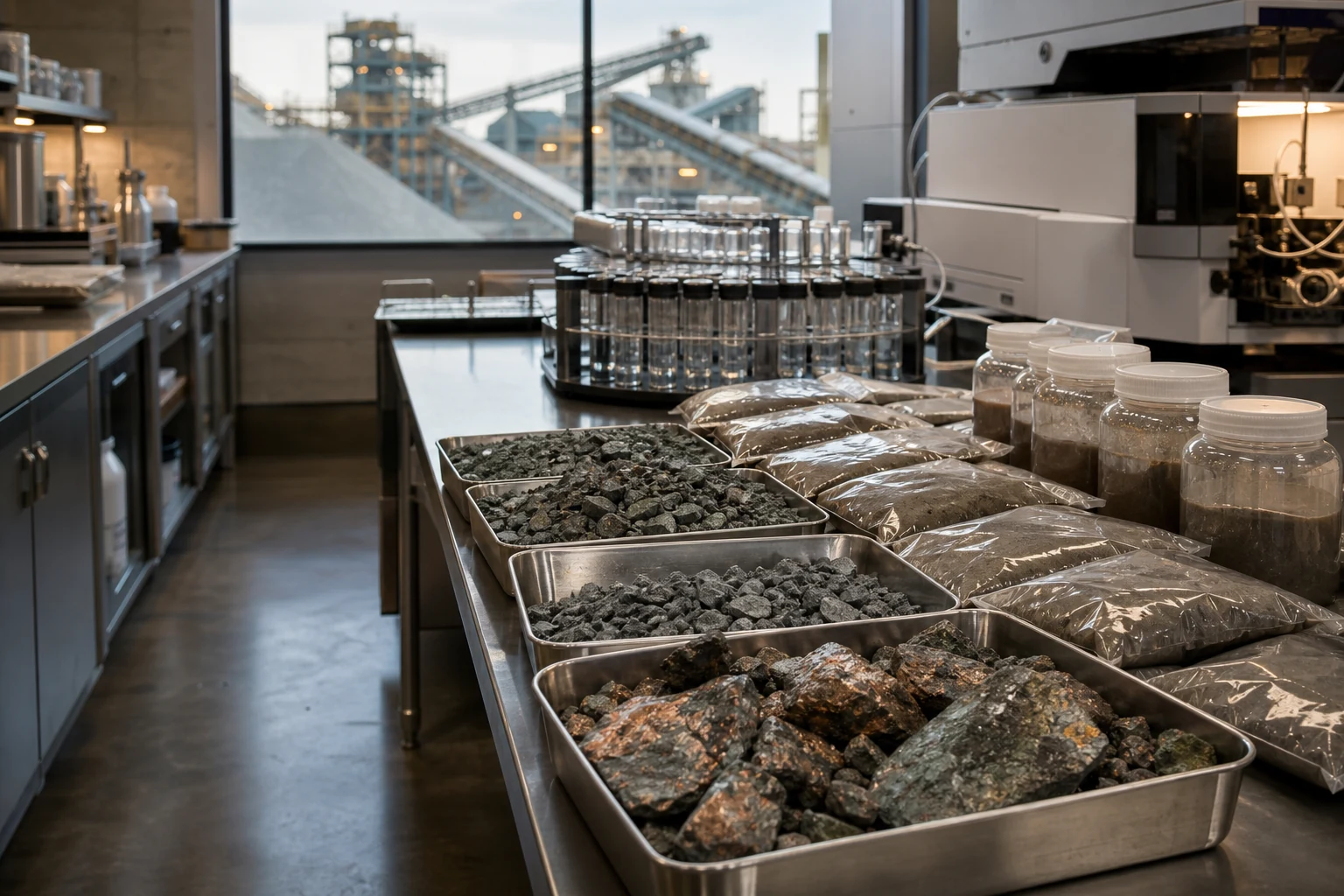
Mine production is not defended by one report. It depends on whether measurements from grade control, material movement, plant feed, final product, tailings and recovery can be reconciled through a controlled data chain.
A mine does not truly know what it produced until geology, mining, plant and laboratory evidence agree—or until the differences between them can be technically explained.
Production is not one number
A mine may report tonnes mined, tonnes delivered to the run-of-mine pad, tonnes reclaimed from stockpiles, tonnes processed, head grade, recovery, final product and tailings grade. Each number describes a different point in the operation. None can explain the full production period alone.
The geological model estimates what should be present. Grade control provides a closer view before extraction. Dispatch and survey records describe material movement. Stockpile models account for material accumulated, blended or reclaimed. The processing plant measures feed and output. The laboratory provides analytical evidence for the grades and process parameters used throughout the chain.
Mine production reconciliation compares those perspectives. Its purpose is not to force different measurements to match artificially. Its purpose is to determine whether the operation can explain the movement from predicted material to actual production.
When the numbers disagree, the variance may come from geology, sampling, ore loss, dilution, stockpile measurement, moisture, process performance, timing, analytical uncertainty or data handling. The difference is not automatically an error. An unexplained difference, however, is an operational risk.
A LIMS does not calculate this reconciliation. Its role is to preserve the laboratory-controlled inputs—sample identity, method, QA/QC status, approval and revision history—so the reconciliation team can distinguish analytical variance from operational variance.
Planned, mined, processed and recovered describe different realities
Production reconciliation begins by respecting the boundary of each measurement.
| Control point | What it is trying to describe | Typical evidence |
|---|---|---|
| Geological or short-term model | Expected tonnes and grade before mining | Block model, drilling and estimation data |
| Grade control | Local ore/waste definition and routing decisions | Blast-hole, channel or face samples and assays |
| Mine movement | What was extracted and where it was sent | Dispatch, survey, truck and stockpile records |
| Plant feed | Material entering the process during a defined period | Belt scales, feeders, moisture and feed composites |
| Process performance | How metal moved through the circuit | Intermediate streams, solution chemistry and operating data |
| Final product and tailings | Metal recovered and metal remaining | Concentrate, doré, solution, slag or tailings assays |
| Production report | Reconciled operational result | Metallurgical balance, approved assays and period controls |
These control points do not necessarily use the same spatial support, time interval, moisture basis or sampling frequency. A blast-hole assay represents a local decision before material is moved. A stockpile estimate represents a changing inventory. A plant-feed composite may represent several hours or an entire shift. A final product result describes a downstream output after blending and processing.
Comparing them without preserving this context can create a false variance. Reconciliation requires more than placing values in adjacent spreadsheet columns. The organization must know what each value represents.
Where variance enters the production chain
The first source of uncertainty appears before the laboratory. A sample must represent the material or interval assigned to it. If collection introduces bias, or if sample mass and particle size are not managed correctly, later preparation and analysis cannot reconstruct the missing representativeness.
Further variance can enter through:
- geological contacts that differ from the interpreted model;
- ore loss and dilution during extraction;
- incorrect material classification or routing;
- stockpile mixing, segregation or incomplete movement records;
- survey and density assumptions;
- inconsistent wet- and dry-basis calculations;
- different production cut-off times between departments;
- composite samples that do not represent the reporting period;
- preparation, subsampling or analytical error;
- preliminary results used before QA/QC approval;
- re-assays or corrections that are not propagated to downstream systems;
- transcription, unit-conversion or version-control failures.
For this reason, grade control reconciliation is not only a geology exercise, and mine-to-mill reconciliation is not only a plant calculation. Both depend on measurement systems that preserve identity, context and status across organizational boundaries.
The laboratory enters the production model at several points
The mining laboratory may analyze samples from exploration, grade control, run-of-mine material, stockpiles, plant feed, intermediate process streams, concentrate, doré, slag, solutions and final tailings. Each sample has a different operational purpose.
Grade-control assays can influence ore/waste classification and destination. Feed composites support interpretation of head grade. Concentrate or doré assays support final product reporting. Tailings results help explain recovery loss. Moisture, density, total solids, pH and solution chemistry may provide additional context depending on the commodity and process.
The laboratory does not calculate every production number, and an assay alone does not diagnose the mine or plant. Its responsibility is narrower and critical: protect the analytical evidence used by the people and systems that perform those calculations.
This means preserving:
- the sample identity and sampling point;
- the collection or composite period;
- preparation and subsampling history;
- analytical method and revision;
- original instrument or worksheet source;
- units, detection limits and calculation context;
- certified reference materials, blanks, duplicates and controls;
- QA/QC exceptions and their disposition;
- re-assays and the relationship to the original result;
- preliminary, approved and published status;
- supervisor approval and revision history.
Without this context, the plant receives a number. With it, the plant receives evidence.
Sampling evidence determines how far reconciliation can go
Research applying the Theory of Sampling to underground mine grade control shows that sampling errors can propagate from primary collection through preparation, subsampling and analysis. This is especially important in heterogeneous ores and gold operations, where particle distribution and the nugget effect can make representativeness difficult.
A precise instrument result cannot compensate for a biased field sample. Likewise, a representative sample can lose value if preparation, identification or result handling is uncontrolled.
This creates an important boundary for production reporting: the laboratory can verify how a received sample was prepared, analyzed, reviewed and approved, but it cannot retroactively prove that the original field sample represented the full block, stockpile or process stream unless the upstream sampling evidence is also controlled.
A defensible reconciliation process therefore connects physical sampling and analytical governance. It does not treat the final assay as an isolated truth.
Timing and result status matter as much as the value
A production period may close before every laboratory result is final. Operations may work with provisional values while the laboratory completes QA/QC review, repeats an analysis or investigates a control failure. That is operationally understandable, but the status difference must remain visible.
If a preliminary result enters a shift report and is later replaced, the organization must know:
- which value was originally used;
- why it changed;
- who approved the revision;
- when downstream systems received the new value; and
- which production reports were affected.
Silent replacement weakens reconciliation. It can make two departments appear to disagree when they are simply using different versions of the same result.
A controlled laboratory lifecycle separates work that is pending, ready for review, approved and published. It also preserves the original and revised values instead of allowing the analytical record to be overwritten without explanation.
Production reconciliation is a data-integrity problem
A monthly metal balance may look like a calculation, but the confidence behind it comes from the data chain. This is laboratory data integrity in operational form: every reported value must remain connected to the evidence that gives it meaning.
Consider a plant feed grade that differs from the grade predicted by mine movement and stockpile models. The first reaction may be to question the geological estimate or plant sampling. A structured investigation asks more precise questions:
- Were both values calculated on the same dry basis?
- Do the reporting periods begin and end at the same time?
- Was reclaimed stockpile material included?
- Does the feed composite represent the tonnes processed?
- Did the assay batch pass its QA/QC controls?
- Was the result re-assayed or revised?
- Did the historian, ERP or production report receive the approved version?
The same discipline applies when recovery changes. A higher tailings grade may reflect process loss, changing ore mineralogy, sampling variability or analytical uncertainty. The laboratory result does not choose the diagnosis. It makes a reliable diagnosis possible by preserving the evidence required to distinguish among causes.
This is why tailings are the final audit trail of the process, and why an approved assay can later influence metallurgical accounting and financial inventory.
Where OnLIMS fits—and where it does not
OnLIMS supports the laboratory-controlled portion of the production evidence chain.
Its mining laboratory LIMS manages batch jobs for finite exploration and grade-control campaigns, as well as routine jobs for fixed plant and production sampling points. Samples and results move through a controlled Pending, Ready, Approved and Published lifecycle. OnLIMS preserves field-level changes, user actions and timestamps, while OnQC supports QA/QC review for certified reference materials, blanks, duplicates and controls.
For plant and smelter environments, OnLIMS metallurgical laboratory software supports recurring feed, concentrate, tailings, matte, slag and shift-composite workflows. Approved laboratory results can be exported through controlled file or ODBC interfaces to production systems, ERP platforms and plant historians.
OnLIMS does not replace:
- the geological or short-term mine model;
- the mine dispatch or fleet-management system;
- stockpile survey and inventory control;
- belt scales or process instrumentation;
- a representative sampling plan;
- the metallurgical accounting model; or
- the professional judgment of geologists, metallurgists and production accountants.
Its role is to ensure that the analytical values entering those systems remain connected to their samples, methods, instruments, QA/QC decisions, approvals and revisions.
That boundary matters. A LIMS should not claim to make the mine reconcile automatically. It should make the laboratory evidence behind reconciliation controlled, traceable and defensible.
From unexplained variance to defensible production
The objective of mine production reconciliation is not perfect numerical agreement. Mining and processing involve heterogeneous materials, different measurement supports and legitimate uncertainty. The objective is explainability across grade control, stockpile reconciliation, metallurgical accounting and mine production reporting.
A defensible production number should allow the operation to trace the path from expected grade and tonnes to material movement, plant feed, final product and losses. When a variance appears, teams should be able to isolate whether it is more consistent with geology, mining, stockpiles, sampling, processing, laboratory measurement or data transfer.
That requires every department to control its part of the evidence chain. For the laboratory, the critical contribution is not simply producing more assays or reporting them faster. It is ensuring that each result remains technically interpretable after it leaves the laboratory.
A mine that cannot defend the data chain cannot fully defend the production number.
Trace one real production period
Select one production period and follow three connected records: a grade-control or stockpile sample, the corresponding plant-feed composite, and the final product or tailings result.
Can the operation identify the sampling period, method, QA/QC status, original instrument record, approval date and revision history behind each value? Can downstream users confirm that they received the approved version?
OnLIMS helps mining and metallurgical laboratories preserve that analytical evidence—from sample registration and instrument capture to QA/QC, approval, publication and controlled export.
Trace your laboratory evidence chain with OnLIMS
Related reading
- Gold Mine Laboratory LIMS
- QA/QC for Mining Laboratories
- Copper concentrate commercial evidence: when one result can change the value of a shipment