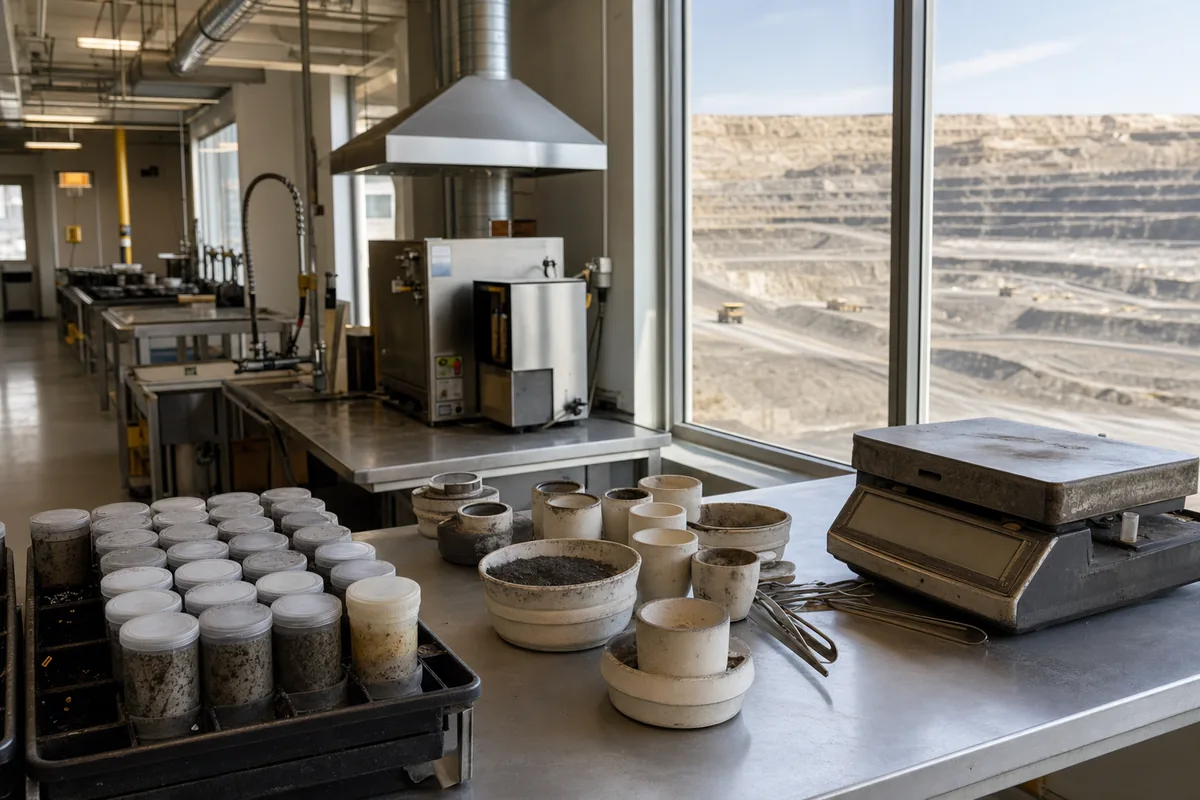
From Gold Assay to Financial Inventory: The Hidden Role of the Mining Laboratory
In a gold operation, a laboratory result rarely remains inside the laboratory. Once a gold assay is validated, approved and released, that number begins to influence decisions far beyond the analytical bench. It can affect grade control, ore routing, stockpile valuation, metallurgical accounting, shipment settlement, budget discipline and board-level production reporting.
This is why the mining laboratory is not only a technical service department. It is one of the control layers that protects the economic interpretation of the mine.
A result reported as grams per tonne may look simple when it appears on a certificate. Behind that number there is a chain of custody, a sample preparation history, an analytical method, instrument calibration, QA/QC evidence, review steps, possible re-assays, approval workflows and revision control. If that path is weak, the economic decisions built on top of the result become harder to defend.
The assay starts before the instrument
The financial value of assay data begins long before the fire assay furnace, ICP, AAS or balance produces a number. It starts with sample identity.
Drill core, blast-hole samples, plant feed, concentrate, tailings, doré, shipment samples and stockpile composites all enter the laboratory with different operational purposes. Some support exploration models. Some guide short-term ore control. Others support metallurgical accounting, environmental monitoring or commercial settlement.
For each of these samples, the laboratory must preserve traceability: where the sample came from, who received it, how it was prepared, which method was applied, which batch it belonged to, which standards, blanks and duplicates were included, and who authorized the final result.
A gold assay without reliable custody is only a number. A gold assay with controlled custody becomes evidence.
From QA/QC to operational routing
In production environments, assay data quickly becomes part of the operating model. Grade control teams use analytical results to classify ore and waste, define stockpile destinations, support blending strategies and forecast mill feed quality. A small delay or quality issue in the laboratory can propagate into operational uncertainty.
If a sample result is released without complete QA/QC review, or if a correction is made outside a controlled audit trail, downstream users may not know whether they are acting on preliminary, revised or final data. That distinction matters when the result is used to move material, estimate head grade or adjust short-term production expectations.
Modern mining laboratories need more than fast reporting. They need governed reporting. Speed without traceability increases risk; traceability without operational usability creates bottlenecks. The value is in connecting both.
Metallurgical accounting depends on laboratory confidence
Metallurgical accounting transforms laboratory data into a picture of process performance. Feed grade, concentrate grade, tailings grade, recovery, mass balance and metal balance depend on analytical results that must be consistent, validated and comparable over time.
When the laboratory controls sample preparation, analytical methods, QC exceptions, re-assays and approvals, the metallurgical team can reconcile production with more confidence. When that control is fragmented across spreadsheets, manual transfers or disconnected systems, reconciliation becomes slower and more vulnerable to dispute.
This is especially important in gold operations, where small differences in grade can represent meaningful differences in contained ounces, recoverable ounces and payable metal. A deviation that looks minor at sample level may become material when multiplied across tonnes, stockpiles or production periods.
Inventory is an economic interpretation of laboratory evidence
Financial inventory in mining is not created by the laboratory alone. It is produced by the interaction of geology, operations, metallurgy, survey, production accounting, finance and commercial settlement. But laboratory data is one of the critical inputs that gives that inventory analytical credibility.
Contained ounces in stockpiles, work-in-process estimates, doré valuation, concentrate valuation, shipment settlement and variance analysis all depend on trusted measurements. The laboratory does not own every downstream calculation, but it must own the integrity of the analytical evidence that feeds those calculations.
This is where a laboratory information management system becomes more than a database. A mining laboratory LIMS acts as the system of record for sample identity, method execution, QA/QC validation, instrument data capture, approval status, revision history and audit trail.
The question is not whether finance should use laboratory data. It already does. The real question is whether the organization can prove which laboratory data was used, when it was approved, who reviewed it, whether it was revised, and how it connects back to the original sample.
Auditability protects both operations and finance
Auditability is often discussed as a compliance requirement. In mining laboratories, it is also an economic safeguard.
A defensible audit trail links the final result back to sample reception, preparation, method, batch, instrument, calibration or QC event, analyst action, supervisor approval and any later revision. This matters for ISO 17025 alignment, internal governance, customer confidence, shipment disputes and executive reporting.
When inventory, recovery or settlement numbers are questioned, the organization needs more than final values. It needs the evidence path.
A strong LIMS does not replace professional judgment. It preserves the conditions under which professional judgment can be trusted. It allows the laboratory to flag exceptions, enforce approvals, separate preliminary from final results and keep historical revisions visible instead of silently overwritten.
The hidden role of the laboratory
The mining laboratory is often measured by turnaround time, throughput and analytical accuracy. Those metrics matter. But they do not fully describe the laboratory’s role in the economic governance of a mine.
A validated gold assay becomes part of the mine’s decision infrastructure. It can influence where material moves, how recovery is interpreted, how stockpiles are valued, how production is reconciled and how financial inventory is explained.
For that reason, laboratory data integrity is not a back-office concern. It is a production, metallurgical and financial control issue.
A mining laboratory LIMS should be evaluated in that context: not as generic software, but as the integrity layer that connects chemistry, custody, QA/QC, operations and financial confidence.